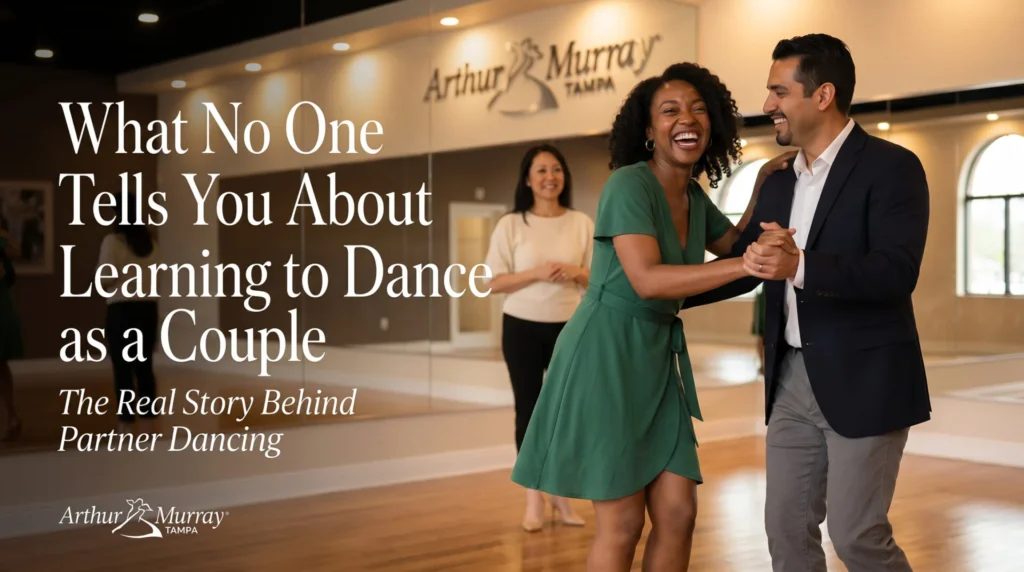
Most couples who decide to take dance lessons together arrive at Arthur Murray Tampa with roughly the same expectation: they’ll learn some steps, move in sync, and leave feeling like they just starred in a movie montage. What actually happens in those first few lessons is both messier and more meaningful than that — and nobody really prepares you for it.
This isn’t a warning. It’s an orientation. Because the couples who know what’s coming are the ones who get through the early awkwardness quickly, find their rhythm together, and end up doing something genuinely rare: building a shared skill that keeps paying them back for years.
The First Honest Truth: You Will Frustrate Each Other
It’s going to happen. Maybe in the first lesson, maybe in the third, but at some point one of you is going to go the wrong direction and take the other one with you, and for a brief moment it will feel like it might be a bigger deal than it actually is.
Learning to dance as a couple puts both people in an unfamiliar physical and communicative situation simultaneously. The lead — traditionally but not exclusively the man — has to think about where they’re going, signal that intention clearly through their frame and body position, and do all of this while also trying to remember a step pattern they learned twelve minutes ago. The follow has to resist the instinct to anticipate or back-lead, trust signals they can barely feel yet, and move in response to a partner who is also figuring things out in real time. That’s a lot of coordination to develop all at once, and it doesn’t always go smoothly.
What catches couples off guard is that the frustration tends to surface not as frustration with the dancing, but as frustration with each other. The lead feels like the follow isn’t responding. The follow feels like the lead isn’t being clear. Both are correct, and neither is at fault — it’s just the natural friction of two people learning a new physical language together from scratch. Knowing that this is a normal, almost universal part of the process doesn’t eliminate the friction, but it changes how you interpret it. It’s not a sign that you’re incompatible as dance partners. It’s a sign that you’re actually learning.
The Lead and Follow Dynamic Changes How You See Each Other
Here’s something couples don’t expect: the lead and follow structure in partner dancing has a way of surfacing relationship dynamics that you didn’t know were there.
A partner who is accustomed to controlling situations in daily life often struggles to follow without trying to steer. A partner who tends toward people-pleasing sometimes has difficulty making clear, committed leads because they’re too worried about getting it wrong. These aren’t character flaws — they’re just patterns that become visible when you’re asked to communicate entirely through physical connection, without words, in real time.
Most couples find this genuinely interesting once they get past the initial surprise of it. Dance becomes a kind of laboratory for nonverbal communication, and the skills you develop in the studio — giving a clear signal, receiving one without overriding it, moving together without either person disappearing into the other — have a way of quietly transferring into how you operate as a couple outside the studio as well. This is not a metaphor. Couples who stick with dancing long enough consistently report that it changes something in how they communicate, and they usually can’t fully explain why. The instructors at Arthur Murray Tampa see it regularly.
One of You Will Progress Faster Than the Other — And That’s Fine
This is the thing that creates the most unnecessary anxiety in couples who are new to dancing together, so it’s worth addressing plainly. In almost every couple that walks into a dance studio, one person picks up the material faster in the early stages. It doesn’t predict who will ultimately be the better dancer. It doesn’t mean one person is more athletic or more musical. It usually just reflects who happens to find the particular rhythm or movement style more intuitive at the start.
What matters is what you do with that gap. The partner who is progressing faster has a choice: they can get impatient, or they can become an asset. The best dance partners are not the technically superior ones — they’re the ones who make it easier for their partner to succeed. A lead who gives clear, patient signals is infinitely more valuable than one who executes perfect footwork but leaves their follow scrambling. A follow who stays present and responsive gives their lead the confidence to try things they aren’t sure about yet. Learning to be that kind of partner is its own skill, and honestly it’s one of the more valuable things dancing teaches.
Your instructors at Arthur Murray Tampa will work with both of you, often coaching each role separately before bringing you back together, precisely because the development isn’t always linear or parallel. The goal isn’t to get you to the same place at the same time. The goal is to get you dancing together well, and that’s a different thing.
What Actually Happens When It Clicks
There is a moment — and it comes for almost every couple that sticks with it — where the two of you are moving together and you both feel it at the same time. The steps aren’t something you’re thinking about anymore. You’re actually dancing. It’s brief at first, maybe just a few counts of music, but it’s unmistakable and it’s shared, and it belongs entirely to the two of you.
That moment is what couples who have been dancing for years are trying to describe when they say dancing changed their relationship. It’s not that dancing is a relationship therapy tool, though there’s real research suggesting it does strengthen emotional connection. It’s that the experience of building something physical together — something that requires trust, communication, and showing up consistently — creates a kind of bond that’s hard to manufacture any other way.
Couples who start at Arthur Murray Tampa for a one-time date night experience and end up enrolling in ongoing lessons aren’t being impulsive. They got a taste of that feeling in the introductory lesson, or even just a glimpse of what it could become, and they recognized it as something worth pursuing. Six years later — like more than one couple in our reviews — they’re still coming in, and date night has become a standing appointment.
A Few Practical Things Worth Knowing Before You Start
- Come in the same car if you can. The conversation on the way home after a lesson is often where the real processing happens — what felt good, what was confusing, what surprised you about yourself or your partner. That debrief is part of the experience.
- Don’t practice at home until your instructor tells you you’re ready to. It sounds counterintuitive, but couples who try to drill material at home before they have a solid enough foundation tend to reinforce each other’s mistakes rather than correct them. Your instructor will tell you when home practice will help rather than hurt.
- Agree before you walk in that neither of you is allowed to teach the other during the lesson. This is the number one source of unnecessary tension in couples who are learning together. You both have the same instructor. Let them do their job, and save the coaching instinct for literally any other area of your relationship.
- Give it at least four lessons before you form an opinion. The first lesson is disorientation. The second is the beginning of pattern recognition. The third is where most couples have their first real moment of feeling like dancers. The fourth is where you start to believe it might actually stick. Showing up for all four before deciding whether it’s for you is the minimum fair test, and almost everyone who makes it to lesson four keeps going.
Frequently Asked Questions
What if one of us is a complete beginner and the other has some experience?
This is more common than you’d think, and it’s entirely manageable. Instructors at Arthur Murray Tampa work with mixed-experience couples regularly. The more experienced partner is often asked to set aside what they think they know and start from the studio’s foundational method — which usually improves their technique as well. The gap tends to close faster than either person expects.
Does it matter who leads and who follows?
Traditionally in partner dancing the lead role has been associated with men and the follow with women, but at Arthur Murray Tampa the assignment is based on what makes sense for each couple. Some couples swap roles entirely. Others find that the non-traditional assignment actually works better for them. Your instructor will help you figure out what fits.
What if one of us really doesn’t want to be there?
It happens. One partner is enthusiastic, the other is being a good sport. The reluctant partner almost always comes around by the end of the first lesson — not always, but most of the time. If they don’t, a conversation about whether to continue is worth having before lesson two rather than after lesson five.
How often should couples take lessons to make real progress?
Once a week is the sweet spot for most couples. It’s frequent enough that material doesn’t evaporate between sessions, and spaced enough that each lesson builds on something that had time to settle. Couples who can only manage every other week can still make meaningful progress — it just takes longer to reach the moments that make it feel effortless.
Is it awkward to take lessons with a partner in a studio with other couples?
Briefly, for the first ten minutes of the first lesson, yes. By lesson two it’s completely normal. Arthur Murray Tampa’s studio culture is warm and non-judgmental, and every couple in the room is navigating their own version of the same learning curve. Nobody is watching you because they’re all thinking about their own footwork.
What You’re Actually Signing Up For
Learning to dance as a couple is not really about dancing. It’s about choosing to do something difficult together, staying in the room when it gets awkward, and building something neither of you could build alone. The dancing is the mechanism. The outcome is a shared language, a standing reason to look forward to a weeknight, and the particular kind of closeness that comes from having figured something out together.
Arthur Murray Tampa’s introductory lesson is free, takes about an hour, and requires nothing from you except showing up. Everything else — the technique, the timing, the moments where it suddenly works — comes after that.