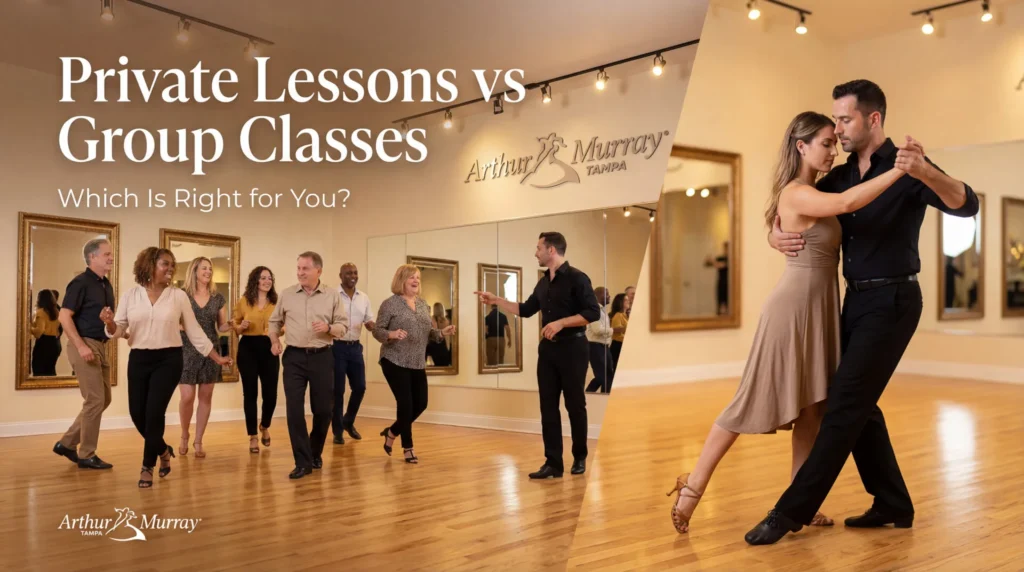
When people start looking into dance instruction in Tampa, one of the first decisions they face is also one they often feel underprepared to make: private lessons or group classes? It sounds like a simple question, but the answer depends on who you are, what you’re trying to accomplish, and how you learn best. Get it right and your progress accelerates. Get it wrong and you may find yourself frustrated or plateaued before you’ve really begun.
This isn’t a case where one format is objectively better than the other. Both private dance lessons and group classes have real, distinct advantages — and understanding those differences will help you make a choice you’re confident in.
What Private Dance Lessons Actually Give You
The defining feature of one-on-one dance instruction isn’t just the personal attention, though that matters enormously. It’s the ability to slow down exactly where you need to slow down and accelerate exactly where you’re ready to move faster. In a private lesson at Arthur Murray Tampa, the curriculum bends to you — not the other way around.
If you’re working on a specific skill and it’s not clicking, your instructor can spend twenty minutes on that one thing without any obligation to keep pace with a group. If you pick something up quickly, you move on immediately rather than waiting for everyone else to catch up. Over time, this responsiveness compounds. Students in consistent private lessons almost always develop faster than students in group settings alone, simply because every minute of instruction is calibrated to their specific needs.
Private lessons are also where technique gets built properly. The details that separate competent dancing from genuinely impressive dancing are difficult to address in a group setting where an instructor is managing multiple students at once. These details include:
- Weight transfer
- Frame
- The quality of a turn
- The subtlety of leading or following
In a private lesson, your instructor can feel what you’re doing as your partner and give you feedback that is immediate, specific, and physically meaningful. That kind of correction is irreplaceable.
For students with a specific goal and a defined timeline — a first wedding dance, an upcoming competition, a milestone event — private lessons are almost always the right primary format. The focused, efficient nature of one-on-one instruction is purpose-built for exactly that situation.
What Group Dance Classes Give You That Private Lessons Can’t
Here’s something that surprises a lot of students: group classes develop a skill that private lessons simply cannot replicate, no matter how good the instruction is. That skill is adaptability — the ability to dance with someone you’ve never danced with before, read their timing and balance, and find a rhythm together in real time.
In a private lesson, you dance with one instructor who knows your tendencies, anticipates your habits, and adjusts for your patterns automatically. That’s enormously valuable for building technique, but it also creates a kind of comfort zone that can make social dancing feel harder than it should. Group classes, where you rotate partners regularly, train you to be a versatile dancer. You learn to lead or follow someone whose style is completely different from what you’re used to, and that exposure makes you significantly more capable on any social dance floor.
Group classes also carry an energy that private lessons don’t. There’s something motivating about moving through a combination alongside other students, laughing at the same stumbles, celebrating the same breakthroughs. The social dimension of group instruction keeps a lot of students engaged and consistent in ways that the quieter environment of a private lesson sometimes doesn’t. For people who are energized by being around others, group classes can make the difference between showing up every week and gradually losing momentum.
The other practical advantage is cost. Group dance classes are considerably more accessible from a pricing standpoint than private instruction, which means students who are early in their journey and not yet sure how serious they want to get can start building a foundation without a significant financial commitment.
The Case for Doing Both
At Arthur Murray Tampa, the most successful students — the ones who progress fastest, stay most engaged, and ultimately become the dancers they set out to be — almost always use both formats in combination. And the logic for that is straightforward once you understand what each one is doing for you.
Private lessons build your technique. Group classes test it. One-on-one instruction gives you the tools; rotating through partners in a group class shows you whether you actually have them. Students who only take private lessons sometimes discover, the first time they dance with a stranger, that their skills are more instructor-dependent than they realized. Students who only take group classes often plateau because the personalized correction that would push their technique to the next level never comes.
Used together, the two formats reinforce each other in a way that accelerates development significantly. A reasonable approach for most beginners is to start with private lessons to build a solid technical foundation, then add group classes once the basics are stable enough that rotating partners is productive rather than disorienting. Your instructor at Arthur Murray Tampa will help you find the right balance based on your goals, your schedule, and how you’re progressing.
How to Decide What’s Right for You Right Now
If you have a specific goal with a deadline — a wedding, a recital, a performance — start with private lessons and build your group class involvement as a supplement once your fundamentals are in place. The focused instruction will get you ready faster and with less wasted time.
If you’re approaching dance as a long-term hobby with no particular urgency, a combination from the beginning often works beautifully. A private lesson or two each month keeps your technique developing in the right direction, while regular group classes give you the social experience and variety that make dancing genuinely fun to stick with.
If cost is a primary consideration and private lessons aren’t currently feasible, starting with group classes is absolutely a legitimate path. You’ll build a foundation, get comfortable in the studio environment, and develop a sense of which styles and goals resonate with you before deciding whether to invest in private instruction.
What you shouldn’t do is let the decision become a reason to delay starting. Both formats will move you forward. The gap between the best choice and the second-best choice is far smaller than the gap between starting and not starting.
Frequently Asked Questions
Are private dance lessons worth the cost?
For students with specific goals, a defined timeline, or a desire to develop technique seriously, private lessons deliver a return on that investment that group classes alone can’t match. The personalized instruction, the pace flexibility, and the quality of feedback make a measurable difference in how quickly and how well you develop as a dancer.
Can a complete beginner start with group classes?
Yes, though it requires a bit more tolerance for the early uncertainty. Group classes move at a set pace, which means you may occasionally feel behind or like you missed something. Many beginners find it helpful to take one or two private lessons first to get comfortable with the basics, then join group classes with enough foundation to follow along confidently.
How often should I take private dance lessons to see real progress?
One private lesson per week is a reliable cadence for steady, visible improvement. Less frequent than that can work, especially when supplemented with group classes or practice time, but once a week tends to be the threshold where skills accumulate rather than reset between sessions.
What’s the difference between private dance lessons and one-on-one instruction at a general gym or community center?
The Arthur Murray method is a structured, progressive curriculum taught by trained instructors — not a generalist fitness environment. Private lessons here build on each other deliberately, with your instructor tracking your development and adjusting the plan as you grow. The quality of instruction and the intentionality of the curriculum are meaningfully different from informal one-on-one sessions elsewhere.
Do group dance classes in Tampa require a partner?
Not at Arthur Murray Tampa. Partners rotate in group classes, so you’ll dance with multiple people over the course of a single session. Solo students are fully accommodated and often find the partner rotation to be one of the most valuable parts of the experience.
The Right Format Is the One You’ll Actually Stick With
All of the strategic reasoning about technique development and skill transfer only matters if you keep showing up. The best dance instruction format for you is ultimately the one that fits your life, excites you enough to stay consistent, and moves you toward whatever brought you through the door in the first place.
Arthur Murray Tampa offers both private dance lessons and group classes, and our instructors are happy to talk through your goals and help you find the right starting point. If you’re ready to begin — or even just ready to ask a few more questions — reach out and schedule an introductory lesson. The decision gets a lot easier once you’ve experienced the studio for yourself.