There’s a moment in every good samba where the dancer stops thinking and starts flying. The rhythm takes over, the bounce becomes automatic, and what started as a series of steps becomes something closer to pure joy expressed through movement. That moment is what samba is really about — and it’s available to anyone willing to learn, right here at Arthur Murray Tampa’s Hyde Park studio.
Samba is the heartbeat of Brazil, the dance of Carnaval, and one of the most exhilarating styles you can learn. It’s fast, it’s bouncy, it’s endlessly fun, and it carries a spirit of celebration that’s unlike anything else in the Latin dance family. If you’ve ever watched footage of Rio’s Carnaval and felt something stir — that irresistible pull toward the rhythm and the joy of it — samba is the dance that lets you feel that from the inside rather than just watching it from a distance.
What Samba Actually Is
Samba is Brazil’s national dance, born from the cultural fusion of African rhythms and Brazilian musical tradition, and it exists in several forms — from the solo street samba of Carnaval to the partner samba danced in ballrooms around the world. The ballroom samba taught at Arthur Murray Tampa is a partner dance that captures the energy and bounce of the Brazilian tradition while giving it the structure and connection of ballroom technique.
The defining feature of samba is its bounce — a distinctive vertical action created by a specific bending and straightening of the knees that produces the characteristic samba “lift.” This bounce is what makes samba instantly recognizable and what gives it its joyful, buoyant quality. The rhythm is quick and syncopated, and the movement travels around the floor with a rolling, bouncing momentum that’s genuinely exhilarating to execute once it clicks.
Samba’s rhythm is more complex than some of the other Latin dances, built on a quick, driving beat with syncopation that gives the dance its forward-rolling energy. Where a dance like merengue steps evenly on every beat, samba plays with the timing in ways that create its signature bounce and drive. This makes it a slightly more advanced rhythm to master, but the payoff is one of the most physically joyful dances in the entire repertoire.
The music itself is impossible to sit still to. Brazilian samba music is built around layered percussion, driving rhythm, and an infectious energy that does something to the body almost involuntarily. When samba music is playing, the urge to move is nearly universal — and learning to channel that urge into actual samba technique is one of the more delightful experiences in Latin dancing.
The Energy That Sets Samba Apart
Every Latin dance has its own emotional character, and samba’s is unmistakable: pure, unfiltered celebration. Where rumba is romantic and bolero is dramatic, where salsa is fiery and cha-cha is playful, samba is joyful in a way that’s almost impossible to fake. The dance is built around the spirit of Carnaval — the biggest, most exuberant celebration in Brazil — and that spirit is baked into every element of how it moves and feels.
This makes samba one of the most physically demanding Latin dances, but also one of the most rewarding. The bounce, the speed, the traveling movement, and the sustained energy add up to a genuine cardiovascular workout — samba is one of the styles where students consistently notice they’ve broken a sweat and elevated their heart rate without ever feeling like they were exercising. For anyone looking for a dance that delivers real physical benefit alongside serious fun, samba is one of the best options available. The energy it demands is exactly what makes it such an effective and enjoyable form of movement.
There’s also something psychologically distinctive about samba. Because its emotional character is so unambiguously joyful, it tends to pull students out of self-consciousness faster than more serious styles. It’s genuinely difficult to dance samba and stay in your head — the bounce and the energy and the sheer momentum of it demand a kind of physical commitment that leaves little room for overthinking. For students who tend to be in their heads, who worry about looking foolish or getting every detail perfect, samba can be liberating in a way that more technical, exposed styles are not. The dance essentially insists that you let go, and letting go is exactly what a lot of beginners most need to learn.
Samba vs. Other Latin Dances
Understanding how samba relates to the other Latin styles helps clarify what makes it distinctive and where it fits in a dancer’s development.
Compared to merengue, samba is significantly more complex and demanding. Merengue steps evenly on every beat with a simple, accessible rhythm; samba layers in syncopation, bounce, and traveling movement that require more coordination and rhythm to execute well. Merengue is the entry point to Latin dancing; samba is a step up that rewards students who’ve developed some rhythmic foundation. The two dances sit at nearly opposite ends of the Latin difficulty spectrum, which makes them useful bookends — merengue to build confidence, samba to challenge and elevate.
Compared to salsa, samba shares a similar level of energy and physical demand but expresses it differently. Salsa’s energy comes through fast footwork, spins, and turn patterns while staying relatively level; samba’s energy comes through the bounce and the traveling, rolling movement around the floor. Both are exhilarating; both are physically demanding; but they feel distinct in the body. Salsa is quick and sharp and turn-heavy; samba is bouncy and rolling and buoyant. Dancers who love one often love the other, and the two together cover a broad range of high-energy Latin dancing.
Compared to the slower Latin dances — rumba and bolero — samba is essentially their opposite. Where those dances ask for slow, controlled, expressive movement, samba asks for speed, energy, and joyful release. A well-rounded Latin dancer benefits from both ends of this spectrum: the sustained expression of the slow dances and the exuberant energy of samba. Learning samba after developing some of the slower styles gives a dancer genuine range, and the contrast makes both kinds of dancing richer.
Samba, Carnaval, and Tampa
There’s a natural seasonal rhythm to samba interest that’s worth knowing about. Carnaval — the massive Brazilian celebration that samba is most associated with — takes place in February, and it draws global attention to Brazilian culture, music, and dance. For anyone who feels inspired by Carnaval imagery and energy, the weeks around February are a perfect time to begin learning samba, channeling that seasonal inspiration into an actual skill.
But samba is a year-round joy, not just a seasonal one. In Tampa — a city with a vibrant Latin cultural scene and a genuine appetite for Latin dance — samba appears at social events, showcases, and celebrations throughout the year. Learning it at Arthur Murray Tampa’s Hyde Park studio means gaining access to a dance that you can enjoy socially in Tampa’s Latin dance community whenever the occasion arises, not just during Carnaval season.
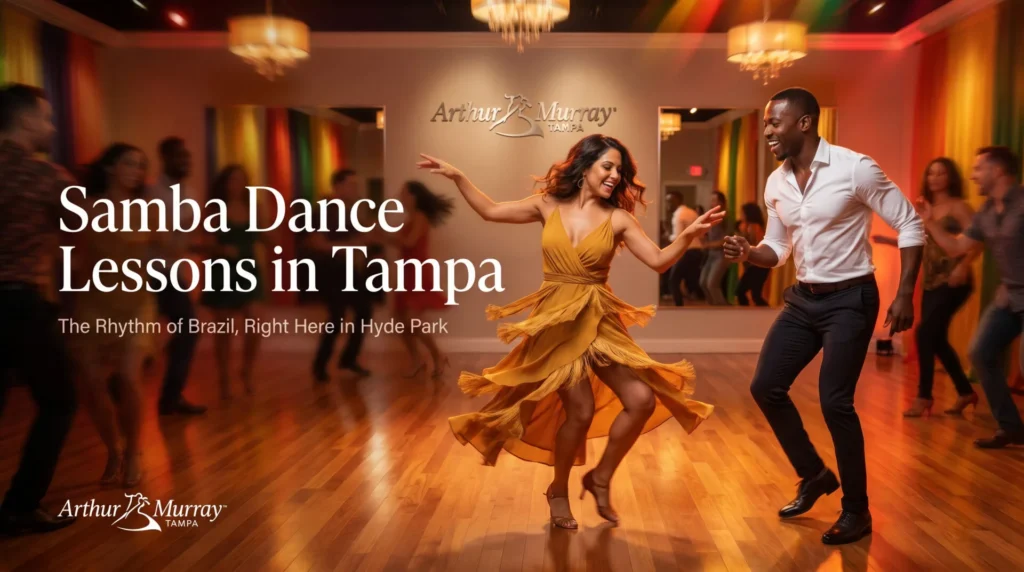
The Hyde Park location itself adds something to the experience. The studio at 2111 W. Swann Ave. sits in one of Tampa’s most vibrant and central neighborhoods, an elegant space with warm lighting, beautiful hardwood floors, and the kind of atmosphere that makes learning a dance as energetic and joyful as samba feel genuinely special. Bringing the rhythm of Brazil into that setting — an upscale, welcoming studio in the heart of South Tampa — creates a wonderful contrast between the exuberant, celebratory nature of the dance and the refined environment in which it’s taught.
What Samba Lessons Look Like at Arthur Murray Tampa
Samba instruction at Arthur Murray Tampa follows the studio’s structured, progressive method, with early attention paid to the foundational element that makes or breaks the dance: the bounce. The samba bounce — that specific knee action that creates the vertical lift and buoyant quality — is the technical heart of the dance, and getting it right early is essential. Instructors spend focused time helping students develop this action correctly, because a samba without a proper bounce is a samba that doesn’t work, no matter how accurate the footwork.
From that foundation, lessons build through the basic samba rhythm and step patterns, the traveling movements that give the dance its rolling momentum, and eventually the turns, combinations, and styling that make samba so exhilarating at higher levels. Because samba’s rhythm is more complex than some Latin styles, the progression is paced to let students genuinely internalize the timing rather than rushing past it — samba rewards patience with its rhythm in a way that pays off as the dance develops.
Private lessons are particularly valuable for developing the bounce and the rhythmic timing, both of which benefit enormously from one-on-one feedback. The bounce is a subtle physical action that’s difficult to develop from watching alone, and an instructor’s real-time correction accelerates the process dramatically. Group classes add the energy and social dimension that samba is all about — dancing samba in a group setting, with the collective energy of multiple dancers moving to that driving Brazilian rhythm, captures something of the communal celebration that samba comes from in the first place.
For students seeking a genuine physical workout alongside their dancing, samba delivers as well as any style in the curriculum. The sustained energy, the bounce, and the traveling movement combine into a legitimately demanding physical activity — one that leaves students energized, accomplished, and often pleasantly surprised at how much of a workout they got while having that much fun.
Frequently Asked Questions
Is samba hard to learn for beginners?
Samba is more challenging than the most accessible Latin dances like merengue, primarily because of its syncopated rhythm and the distinctive bounce that defines it. It’s best suited to students who have developed some rhythmic foundation, though motivated complete beginners can absolutely learn it. The bounce takes focused practice to develop, but once it clicks, the dance becomes one of the most joyful in the repertoire.
What is the samba bounce?
The samba bounce is the distinctive vertical action that gives the dance its buoyant, joyful quality. It’s created by a specific bending and straightening of the knees timed to the rhythm, producing the characteristic samba “lift.” Developing this bounce correctly is the technical foundation of the dance, and it’s one of the main things instructors focus on in early lessons.
Is samba a good workout?
Excellent. Samba’s speed, bounce, sustained energy, and traveling movement combine into a genuine cardiovascular workout. Students consistently notice they’ve elevated their heart rate and broken a sweat while dancing samba, all without it feeling like conventional exercise. For anyone wanting real physical benefit alongside serious fun, samba is one of the best options in the Latin repertoire.
How is samba different from salsa?
Both are high-energy Latin dances, but they express that energy differently. Salsa’s energy comes through fast footwork, spins, and turn patterns while staying relatively level; samba’s comes through the bounce and rolling, traveling movement around the floor. Salsa is quick and sharp; samba is bouncy and buoyant. Many dancers enjoy both, as together they cover a broad range of energetic Latin dancing.
Do I need a partner to take samba lessons at Arthur Murray Tampa?
No. Solo students are fully accommodated in both private lessons and group classes. Instructors partner with individual students during private instruction, and group classes rotate partners so everyone gains experience dancing with different people.
When is the best time to start learning samba?
Any time is a great time, though the weeks around Carnaval in February carry a natural seasonal inspiration, as the celebration draws global attention to Brazilian dance and culture. That said, samba is a year-round joy, and Tampa’s Latin dance community offers opportunities to enjoy it socially throughout the year.
Bring the Rhythm of Brazil Into Your Life
Samba is joy made physical. It’s the dance of celebration, the heartbeat of Brazil, and one of the most exhilarating things you can learn to do with your body. It asks for energy and rewards it with pure delight. It demands that you let go, and it makes letting go feel effortless. And it’s available right now, at Arthur Murray Tampa’s Hyde Park studio, taught by instructors who can help you find that moment where the rhythm takes over and the dancing becomes flying.
Whether Carnaval season has you inspired or you’re simply looking for the most joyful, energetic dance in the Latin repertoire, samba is waiting. Book your introductory lesson at Arthur Murray Tampa and feel the rhythm of Brazil for yourself. It’s more fun than you’re imagining — and you’re closer to it than you think.