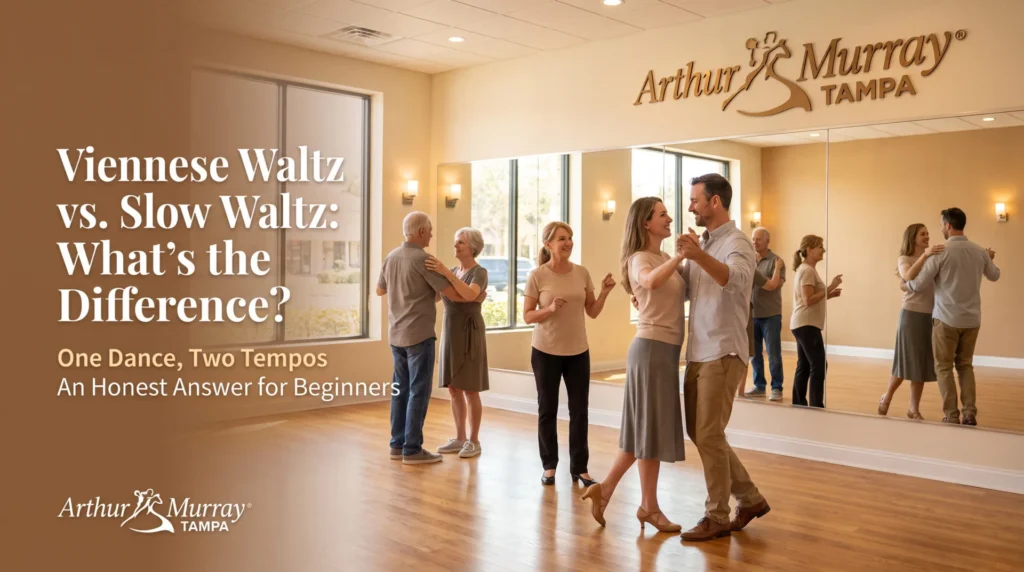
The difference between the Viennese waltz and the slow waltz comes down to speed and character. Slow waltz moves at roughly 28 to 30 measures per minute with rise and fall in every step. Viennese waltz runs nearly twice as fast, uses a smaller pattern vocabulary, and turns continuously around the floor.
Both are ballroom dances in 3/4 time. Both are counted 1-2-3. That shared foundation is why people confuse them, and it is also why learning one makes the other easier.
Viennese Waltz vs. Waltz at a Glance
Here is the short comparison most dancers are looking for.
- Tempo: Slow waltz sits around 28 to 30 measures per minute. Viennese waltz sits around 54 to 60 measures per minute.
- Feel: Slow waltz is broad, sweeping and rise-and-fall driven. Viennese waltz is light, continuous and rotational.
- Pattern count: Slow waltz has a large vocabulary of figures. Viennese waltz is built on a small core of turns and changes.
- Floor travel: Both travel counter-clockwise, but Viennese waltz covers ground much faster and rarely stops rotating.
- Difficulty: Slow waltz is easier to start. Viennese waltz is easier to memorize but harder to control.
Neither one is the “real” waltz. They are two types of waltz that grew from the same 19th-century roots and then developed separately.
What Is a Slow Waltz?
Slow waltz, sometimes called English waltz or international waltz, is the version most people picture at a wedding. It moves at a walking pace. You have time to think between steps, which is exactly why it is the most common first ballroom dance for adults.
The signature of slow waltz is rise and fall. You lower slightly on count one, rise through counts two and three, then lower again to begin the next measure. That gentle swell is what makes the dance look like it is floating rather than marching.
What You Learn First in Slow Waltz
- The box step, which is the foundation figure for both partners.
- The left turning box, which lets you rotate around the room.
- Progressive movement, so you travel down the line of dance instead of staying in one spot.
- Underarm turns and simple partner changes that add variety without adding speed.
Most adults can dance a recognizable slow waltz to real music within a few lessons. That early win matters more than people expect. Confidence in one dance carries directly into the next.
What Is a Viennese Waltz?
Viennese waltz is the original waltz, and it is fast. The music runs at roughly double the tempo of slow waltz, which changes almost everything about how the dance is executed. There is no time for large decorative figures, so the dance strips down to essentials.
The core of Viennese waltz is continuous rotation. Couples turn to the right, turn to the left, and use a change step to switch direction. That is the heart of it. The elegance comes from control and consistency rather than variety.
The Core Viennese Waltz Figures
- Natural turn: a clockwise rotation that travels along the line of dance.
- Reverse turn: the counter-clockwise counterpart.
- Change steps: the transitions that let you move between the two turns without stopping.
Because the pattern list is short, many students find Viennese waltz less mentally demanding than slow waltz. The challenge moves elsewhere. You are managing balance, frame and momentum at speed, and small errors compound quickly when the music does not wait for you.
If you want to see how the dance is structured lesson by lesson, our Viennese waltz program page lays out what students work on at each stage.
How the Two Waltzes Feel Different to Dance
Tempo numbers only tell you so much. The lived difference is in what your body is doing.
In slow waltz, you have room to shape each step. You can stretch a movement, hold a line, and let the rise and fall breathe. Partners have time to communicate through the frame, so lead and follow feels conversational.
In Viennese waltz, the communication happens through momentum. Once the turn begins, both partners are committed to the rotation, and the connection has to stay steady the whole way around. It feels less like a conversation and more like a shared current.
Neither is harder to enjoy. They just reward different things. Slow waltz rewards precision and shaping. Viennese waltz rewards trust and stamina.
Is Viennese Waltz Hard for Beginners?
Viennese waltz is harder to control than slow waltz, but it is not out of reach for a beginner. The honest answer depends on what you find difficult.
- If memorizing steps is your obstacle, Viennese waltz may actually feel easier. There are fewer figures to remember.
- If speed makes you tense up, slow waltz is the better starting point. It builds the frame and balance you will need later.
- If you get dizzy easily, continuous rotation takes some adjustment. Instructors teach spotting and posture adjustments that help most students settle in within a few sessions.
The standard progression is slow waltz first, Viennese waltz second. That order is not a rule so much as a shortcut. Slow waltz teaches timing, frame and rise and fall at a pace where you can actually feel what you are doing. Viennese waltz then becomes a matter of applying those skills faster.
Which Waltz Should You Learn?
Match the dance to the reason you are dancing.
For Wedding Couples
Slow waltz is the safer choice for a first dance. It works with a wider range of songs, it looks polished on video, and it does not require a large floor. Viennese waltz is a strong option if your song is genuinely fast and you have enough space to travel.
For Social Dancers
Learn slow waltz first. It appears more often at social dances and at events around Tampa Bay, and it partners well with foxtrot in terms of technique. Add Viennese waltz once your frame is reliable.
For Competitors
You will need both. Slow waltz and Viennese waltz are separate events in smooth and standard ballroom categories, and they are judged on different qualities. Training them together builds a more complete sense of 3/4 timing.
Learning Both Waltzes in Tampa
Arthur Murray Tampa teaches slow waltz and Viennese waltz as distinct smooth-style programs, each with its own progression rather than treating one as a footnote to the other. That separation matters, because the technique priorities really are different, and blending them tends to leave students shaky at both.
Lessons run at our South Tampa studio in Hyde Park at 2111 W. Swann Ave. and at our Clearwater studio at 25032 US Hwy 19 N. Private lessons let you work at your own pace on frame and balance. Group classes and social dance nights give you the practice hours that turn a learned pattern into something you can do without counting.
You do not need a partner, a background in dance, or any sense of natural rhythm to start. Most adults who walk in have never danced a step. Within a few weeks, most of them are waltzing to real music, and a good number go on to add the Viennese version once the slow one feels like theirs.
The Short Version
Slow waltz is the elegant, moderate-tempo dance with rise and fall and a broad vocabulary of figures. Viennese waltz is its faster ancestor, built on continuous turns and a compact set of patterns. Learn slow waltz first, add Viennese waltz when your frame is steady, and you will have two dances that cover almost any 3/4 song a DJ puts on.