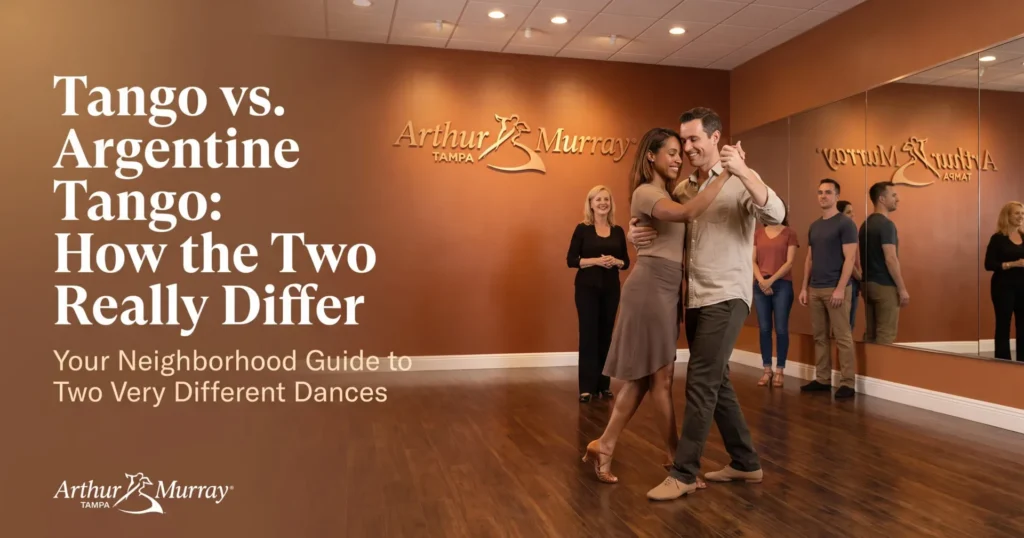
The difference between tango and Argentine tango comes down to the embrace, the frame, and the way each dance moves. Ballroom Tango uses a closed, structured hold with sharp, staccato steps traveling around the floor. Argentine Tango uses a closer, more flexible embrace with improvised, grounded walking and no fixed pattern of travel.
Both are called tango. Both trace back to the same roots in Buenos Aires. But once you stand up and try them, they feel like two different conversations.
At Arthur Murray Tampa, we teach ballroom Tango and Argentine Tango as separate styles, with dedicated instruction for each. That means you can try both under one roof and decide which one fits you, rather than guessing from videos.
Where Both Dances Came From
Tango began in the neighborhoods and social halls of Buenos Aires in the late 1800s. It was danced socially, improvised, and shaped by the crowd around it.
When the dance traveled to Europe and North America in the early 1900s, ballrooms and instructors adapted it. The steps became standardized so they could be taught in sequence, and the dance was arranged to travel counter-clockwise around a large floor alongside other couples.
That adaptation became what we now call ballroom Tango. Meanwhile, the original social form kept evolving in Argentina and is what people mean today when they say Argentine Tango. Neither one is the “real” version. They are two branches of the same tree.
Tango vs. Argentine Tango: The Five Real Differences
Here is what actually changes when you switch between the two styles.
1. The Embrace
Ballroom Tango uses a closed hold with clear space between the partners’ upper bodies. The leader’s right hand sits lower on the follower’s back than in Waltz or Foxtrot, and the follower’s left arm wraps further around. The frame is firm and held.
Argentine Tango uses a softer, closer embrace. Partners often connect chest to chest, and the embrace opens and closes throughout the dance depending on what movement is happening. The arms are relaxed rather than braced.
2. How the Dance Moves
Ballroom Tango is a progressive dance. You travel around the floor in the line of dance, covering ground with long, deliberate steps and crisp changes of direction.
Argentine Tango moves in any direction and often stays in a small area. Couples pivot, pause, step to the side, and change direction on the spot. On a crowded social floor, that compactness is a practical advantage.
3. Rhythm and Timing
Ballroom Tango has a defined staccato quality. Steps land on strong counts, and the classic head snaps and sharp closes are choreographed into the syllabus figures.
Argentine Tango treats timing as expressive. You may walk on the beat, pause for a full measure, or double the speed for a run of quick steps. The music tells you, and the leader chooses in the moment.
4. Pattern vs. Improvisation
This is the difference most students feel first.
- Ballroom Tango is built on named figures learned in a sequence, which makes early progress feel measurable and predictable.
- Argentine Tango is built on a vocabulary of elements the leader combines on the spot, which makes it feel conversational once the basics settle in.
Both are learnable. They simply reward different instincts, and many students end up enjoying both for exactly that reason.
5. Footwork and Posture
Ballroom Tango keeps the knees slightly flexed with a strong, lifted posture and a distinctive walking action that stays low and grounded.
Argentine Tango asks for a settled, weighted stance over the standing leg. Ornaments like small taps and traces of the free foot are part of the style, and followers have more room to add their own.
Which One Should You Learn First?
Start with the one that matches what you want out of dancing.
- Choose ballroom Tango if you want structure, clear milestones, and a dance that fits alongside Waltz, Foxtrot, and Viennese Waltz at social events, weddings, and showcases.
- Choose Argentine Tango if you are drawn to close connection, improvisation, and the specific music and culture of the dance.
- Choose either if you simply love the look of tango and are not sure which one you have been watching. An instructor can show you both in a single lesson and let your body decide.
If you are preparing a wedding dance, ballroom Tango is often the easier fit for a first song because the figures are set and rehearsable. If you are building a long-term social dance habit, Argentine Tango gives you something you can dance for decades without ever repeating yourself.
Is Argentine Tango Hard to Learn?
It is different, not harder. The learning curve is shaped differently from ballroom dances.
In ballroom Tango, you learn a figure and you can dance it that night. In Argentine Tango, you spend more time early on the walk, the embrace, and the shared axis before patterns come. That front-loaded work feels slow for a few weeks, then pays off, because everything after it builds on the same foundation.
What actually determines your progress in either style is consistency and good instruction. Adults who take regular private lessons, attend group classes, and put in social dance time improve steadily regardless of which tango they chose. Complete beginners learn both every week in Tampa and Clearwater.
What a Lesson Actually Looks Like
Nobody expects you to arrive knowing anything. A first lesson in either style starts with posture, weight transfer, and walking, because both tangos are built on how you walk.
From there, the structure is straightforward:
- Private lessons give you individual feedback on your own timing, frame, and balance.
- Group classes let you practice with different partners and learn how the dance adapts to real people.
- Social dance events put it all together on a floor with music, which is where the dance stops feeling like homework.
You do not need a partner. You do not need dance experience. You do not need to decide today which tango is yours.
Try Both and Compare Them Yourself
Reading about the difference between tango and Argentine tango gets you partway. Standing up and feeling the two embraces back to back gets you the rest of the way in about ten minutes.
Because we teach both styles separately at our South Tampa and Clearwater studios, you can experience the contrast without driving across the bay to a second school. Some students commit to one. Plenty study both, and find that each one improves the other.
If the closer embrace and the improvisation are what pulled you into this article, start with Argentine Tango lessons and see how the connection feels. If you want the sharper, traveling version you have seen in ballrooms and competitions, ballroom Tango is waiting on the same floor.
Either way, the first step is showing up. We will handle the rest.