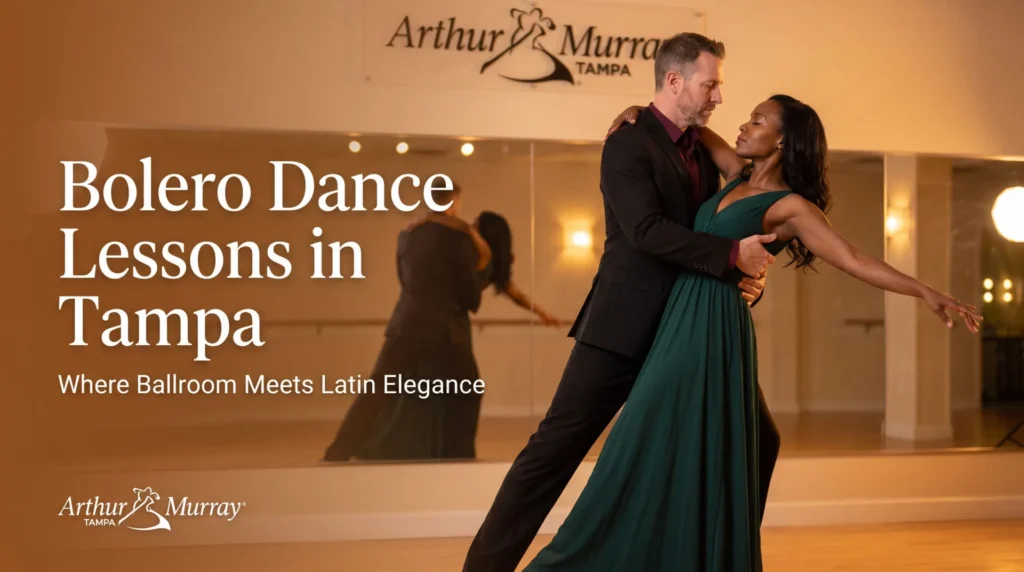
Most people who fall in love with bolero don’t go looking for it. They come to Arthur Murray Tampa wanting to learn salsa, or rumba, or one of the Latin dances they’ve actually heard of — and somewhere along the way, an instructor introduces them to bolero, and something clicks that they weren’t expecting. It’s slower than they thought a Latin dance could be. More dramatic. More emotionally expansive. It asks something different of them than the faster, flashier styles, and for a certain kind of dancer, it becomes the one they didn’t know they were looking for.
Bolero is the quiet sophisticate of the Latin dance family, and it occupies a genuinely unique place: it lives at the intersection of Latin rhythm and ballroom elegance, borrowing the hip action and emotional intensity of the Latin tradition while incorporating the rise and fall and sweeping movement more commonly associated with smooth ballroom dances like the waltz. The result is a dance unlike anything else in the curriculum — and one that rewards the dancers patient enough to learn it properly.
What Bolero Actually Is
Bolero traces its roots to Spain and Cuba, evolving over the late nineteenth and twentieth centuries into the slow, romantic dance that’s taught in ballroom studios today. The music is unhurried and lyrical — built around a slow tempo that gives every movement room to develop fully, to be felt rather than rushed through. Where salsa fills a measure of music with quick, syncopated steps, bolero stretches across the same musical space with deliberate, expressive movement that emphasizes the connection between partners and the emotional content of the music itself.
At a technical level, bolero is built on a slow-quick-quick rhythm pattern, but what distinguishes it from its faster Latin cousins is the rise and fall — the vertical movement borrowed from the smooth ballroom tradition. As a bolero dancer steps, there is a lowering and rising quality to the movement that creates a sweeping, almost oceanic feel. This is unusual for a Latin dance. Most Latin styles keep the movement relatively level, with the expression happening through hip action and footwork rather than vertical rise. Bolero combines both: the Cuban hip motion of the Latin tradition and the rise and fall of ballroom, woven together into something that feels simultaneously grounded and lifted.
This combination is why bolero is often described as the most balletic or the most romantic of the Latin dances. It has a fluidity and an emotional openness that the faster styles, for all their energy and excitement, don’t quite reach. Bolero is not about excitement. It’s about expression — and that distinction shapes everything about how it feels to learn and to dance.
Bolero vs. Rumba: The Distinction That Matters
Because rumba is the Latin dance most often compared to bolero — both are slow, both are romantic, both emphasize connection and hip action — it’s worth being precise about how they differ, since students who love one often love the other, and understanding the contrast deepens both.
Rumba is frequently called the dance of love, and it earns the title through its intimacy and its focus on the connection between two partners. Rumba is danced relatively level, with the expression concentrated in the hips, the slow weight transfers, and the sustained tension of partner connection. It’s intense, deliberate, and inward — a dance that draws the partners toward each other and holds them in a sustained emotional conversation.
Bolero takes that same slow, romantic foundation and adds the dimension of rise and fall, which changes the entire physical character of the dance. Where rumba stays grounded and intimate, bolero rises and sweeps. There’s a grandeur to bolero that rumba doesn’t have — a sense of the movement expanding outward and upward rather than concentrating inward. If rumba is a whispered conversation between two people, bolero is more like a duet that fills the room. Both are romantic. Both are slow. But rumba’s romance is intimate and contained, while bolero’s romance is expansive and dramatic.
For students trying to decide between them, the question is really about what kind of expression resonates. Dancers drawn to the close, sustained intimacy of partner connection often gravitate toward rumba. Dancers drawn to sweeping, dramatic, almost cinematic movement often find their home in bolero. Many students at Arthur Murray Tampa eventually learn both, and discover that the contrast between them makes each one richer.
Why Bolero Rewards Patient Dancers
There’s an honest truth about bolero that’s worth stating directly: it is not the dance to learn if you want the fastest possible path to feeling like a dancer. That distinction belongs to merengue, or to the more immediately gratifying energy of salsa. Bolero asks for patience, and it gives its rewards to the dancers willing to extend it.
The reason is in the tempo. Fast dances are forgiving of imperfection in a particular way — when the movement is quick and energetic, small flaws blur into the overall momentum, and the sheer pace carries a beginner past mistakes before they’re fully noticed. Slow dances offer no such cover. In bolero, every movement is exposed. The slowness that makes the dance so expressive also makes it unforgiving: there is nowhere to hide a rushed weight transfer, an uncertain frame, or a hip action that hasn’t fully developed. The dancer is fully visible in every moment, and that visibility is demanding.
But this same quality is exactly what makes bolero so rewarding to develop. Because the dance is slow and exposed, learning it properly forces a level of attention to technique, balance, and expression that accelerates a dancer’s overall development more than almost any other style. Students who invest in bolero tend to come away with:
- Better posture and improved body alignment
- Better balance developed through slow, controlled movement
- More refined hip action
- A deeper sense of musicality and partner connection
Those qualities transfer directly into every other dance they do. Bolero makes you a better dancer in general, precisely because it refuses to let you get away with anything.
There’s also an emotional dimension to this that’s harder to quantify but real. Bolero asks the dancer to express something — to be present in the music and the connection in a way that the faster, more technical styles don’t demand in the same way. For some students this is intimidating at first; the vulnerability of slow, expressive movement can feel exposing. But for the dancers who lean into it, bolero becomes one of the most personally meaningful dances they learn, because it’s the one that asks them to bring themselves to the floor rather than just their footwork.
What Bolero Lessons Look Like at Arthur Murray Tampa
Bolero instruction at Arthur Murray Tampa follows the studio’s structured, progressive method, but the pacing reflects the nature of the dance. Where a faster style might have a beginner executing recognizable patterns within the first lesson, bolero instruction often spends more early time on the foundational elements — the slow-quick-quick rhythm, the rise and fall, and the hip action — because getting these fundamentals right is what makes the dance work. Rushing them produces a bolero that looks and feels wrong, and instructors know that the investment in fundamentals pays off as the dance develops.
Private lessons are particularly valuable for bolero because so much of the dance lives in subtle technical details that are difficult to develop without one-on-one feedback. The quality of the rise and fall, the timing of the hip action relative to the weight transfer, the sustained connection with a partner through slow movement — these are things an instructor needs to feel and correct in real time, in partnership with the student. The exposed nature of bolero that makes it so demanding also makes qualified, responsive instruction more important than it might be in a faster, more forgiving style.
Group classes add the dimension of dancing bolero with different partners, which builds the adaptability and connection skills that translate to social dancing. Bolero appears at social dance events and showcases, and the experience of dancing it with a variety of partners deepens a student’s understanding of how the connection and lead-follow communication actually work across different bodies and styles.
For couples, bolero holds a particular appeal. The slow, romantic, expressive quality of the dance makes it one of the most rewarding styles for partners who want to develop something genuinely intimate and beautiful together. The patience the dance requires becomes a shared project, and the emotional expressiveness it asks for becomes a form of connection that many couples find deepens their relationship in the way that the best partner dancing tends to.
Where Bolero Fits in Your Dance Journey
Bolero is rarely anyone’s first dance, and that’s appropriate — it’s a style that gives the most to dancers who already have some foundation in rhythm, partner connection, and basic technique. For that reason, it often enters a student’s repertoire after they’ve established themselves in one or two other styles, when they’re ready for something that will challenge and refine what they’ve already built.
But bolero is worth waiting for, and worth pursuing deliberately when the time comes. In a Latin dance repertoire that might include the energy of salsa, the playfulness of cha-cha, the accessibility of merengue, and the intimacy of rumba, bolero adds something none of the others provide: sweeping, dramatic, expressive elegance that draws on both the Latin and ballroom traditions. It rounds out a dancer’s range in a way that makes the whole repertoire more complete, and it offers a kind of personal, emotional expression on the dance floor that the faster styles, for all their virtues, simply don’t.
For dancers in Tampa who have developed a foundation and are looking for the style that will deepen their artistry, refine their technique, and give them a genuinely romantic and expressive dance to call their own, bolero is the answer. Arthur Murray Tampa offers bolero instruction as part of a complete Latin and ballroom curriculum, and for the right dancer at the right moment, it becomes the one they’re most glad they learned.
Frequently Asked Questions
Is bolero harder to learn than other Latin dances?
Bolero is more demanding in a specific way: its slow tempo exposes every detail of technique, leaving no room to hide imperfections behind speed and momentum. This makes it more challenging for beginners than faster styles like merengue or salsa. However, the difficulty is exactly what makes it valuable — learning bolero properly accelerates overall dance development. It’s best approached once a student has some foundation in rhythm and partner connection.
What is the difference between bolero and rumba?
Both are slow, romantic Latin dances emphasizing connection and hip action, but bolero adds the rise and fall borrowed from smooth ballroom dancing, giving it a sweeping, dramatic quality. Rumba stays grounded and intimate, with expression concentrated in the hips and sustained partner connection. Bolero is more expansive and cinematic; rumba is more contained and intimate.
Do I need previous dance experience to learn bolero?
While not strictly required, some foundation in rhythm, basic technique, and partner connection makes bolero significantly more accessible and rewarding. Many students learn bolero after establishing themselves in one or two other styles. Complete beginners interested in bolero are welcome at Arthur Murray Tampa, but an instructor may recommend building some fundamentals first.
Is bolero a good dance for couples?
Exceptionally so. Bolero’s slow, romantic, and expressive character makes it one of the most rewarding styles for couples wanting to develop something intimate and beautiful together. The patience it requires becomes a shared project, and its emotional expressiveness creates the kind of connection that deepens relationships.
What kind of music is bolero danced to?
Bolero is danced to slow, lyrical, romantic music with an unhurried tempo that allows for full, expressive movement. The musical tradition is rich and emotionally resonant, drawing from Spanish and Cuban roots, and the slow pace gives dancers room to interpret and feel the music rather than simply keeping up with it.
How long does it take to learn bolero?
Because bolero rewards attention to detail and its slow tempo exposes technique, it generally takes longer to feel polished than faster, more forgiving styles. Students should approach it as a longer-term investment that pays dividends across their entire dancing. The timeline varies by individual, prior experience, and lesson frequency, but the refinement bolero develops is worth the patience it asks for.
The Dance Worth Slowing Down For
In a culture that prizes speed and immediate results, bolero is a quiet argument for the opposite. It asks you to slow down, to pay attention, to be fully present in each movement, and to bring something of yourself to the dance rather than just executing the steps. It rewards patience, attention, and emotional openness — qualities that aren’t always easy to summon, but that produce something genuinely beautiful when they are.
For dancers in Tampa ready to add depth, elegance, and expression to their dancing, bolero offers something no other style quite does. Arthur Murray Tampa’s instructors can introduce you to it when the time is right, and for the dancers who connect with it, bolero becomes the style that reminds them why they started dancing in the first place. Book an introductory lesson and begin the conversation about where bolero might fit in your journey.