Every dance studio has a conversation that happens regularly with first-time students. It goes something like this: the person wants to learn Latin dancing, they’re excited about it, and then the anxiety sets in. What if the rhythm is too complicated? What if the footwork is too fast? What if they’re the one person in the room who genuinely, constitutionally cannot find the beat?
The answer instructors at Arthur Murray Tampa reach for most often in that moment is merengue. Not because it’s a lesser dance or a consolation prize for people who can’t handle something more demanding — but because merengue is the Latin dance that removes every barrier between a complete beginner and the actual experience of dancing. And once that experience is real, once you know what it feels like to move with a partner to Latin music and have it work, every other style becomes less intimidating.
Where Merengue Comes From
Merengue is the national dance of the Dominican Republic, and its origins are woven into the cultural and political fabric of the country in ways that make it more than just a dance style — it’s a national identity. The music is built around a two-beat rhythm that is among the most insistent and physically compelling in all of Latin music. When merengue is playing at full volume with a live band, the idea of standing still feels almost physically incorrect. The rhythm does something to the body that most people don’t need to be taught to respond to. They just do.
That responsiveness is not accidental. The merengue rhythm is structured in a way that aligns naturally with the body’s bilateral movement — the alternating weight shift that happens when you walk, when you march, when you move in any natural forward motion. Learning to merengue doesn’t feel like learning an alien movement system. It feels like being shown that something you already do instinctively can be made to look and feel like dancing, because that’s essentially what it is.
The dance spread beyond the Dominican Republic through the Caribbean diaspora and the broader Latin music explosion of the twentieth century, and today it’s a fixture at Latin social events, dance studios, and celebrations across Florida and the rest of the country. In Tampa, with its deep Cuban-American heritage and vibrant Latin social scene, merengue is not a novelty — it’s a dance that people actually use.
Why Merengue Is the Most Accessible Latin Dance for Beginners
The case for merengue as a starting point for Latin dance beginners isn’t just instructional common sense. It’s biomechanically grounded, and understanding why helps you appreciate what you’re actually building when you learn it.
Most Latin dances require a beginner to simultaneously manage an unfamiliar rhythm, a step pattern that doesn’t map to natural walking movement, and the physical communication of partner connection — all at the same time, from the very first lesson:
- Salsa asks you to find a syncopated beat that sits slightly off the obvious pulse of the music and step on counts that feel counterintuitive until they don’t.
- Bachata gives you a cleaner rhythm but requires hip action that takes real body awareness to develop naturally.
- Cha-cha has that signature triple step that confounds beginners reliably for the first several lessons.
Merengue asks you to do one thing: step side to side or in place on every beat of the music, alternating your weight as you go. That’s the entire foundation. It is, at its most basic, walking in place with your hips engaged. The rhythm is so direct and so aligned with natural human movement that most beginners execute a recognizable merengue basic within the first five minutes of their first lesson — not because they’re talented, but because the dance meets them where their body already is.
This matters enormously for beginners, and not just for practical reasons. The psychological effect of feeling like a dancer early — of moving with a partner to music and having it feel like something rather than nothing — cannot be overstated. Dance instruction research and the lived experience of Arthur Murray Tampa instructors consistently show that students who have an early success experience stay in lessons longer, progress faster across all styles, and develop a confidence in their own physical ability that shapes their entire trajectory as dancers. Merengue is often that early success experience for Latin dance beginners.
What Merengue Looks and Feels Like
Beginners sometimes arrive with a mental image of merengue that undersells it — they think of it as simple and therefore assume it must look simple. What they discover in lessons is that a well-danced merengue is anything but basic. The hip action that develops with proper technique — the Cuban motion that gives Latin dancing its visual signature — is expressed beautifully in merengue because the even, alternating rhythm gives it constant space to breathe. Advanced merengue dancers look fluid, musical, and effortlessly sensual in a way that reflects years of refinement, not a lack of complexity.
The social merengue you’ll learn at Arthur Murray Tampa begins with that foundational march step and builds progressively through partner connection, turns, simple patterns, and eventually the more complex combinations and styling that characterize the dance at higher levels. The floor is the same one that produces beginners who can enjoy a merengue at a Latin social event after just a handful of lessons, and intermediate students who look genuinely impressive doing it. The ceiling is high. The floor is just unusually accessible.
In terms of physical feel, merengue in a close partner embrace has a particular warmth and playfulness that distinguishes it from the more intense connection of bachata or the energetic urgency of salsa. It’s a festive dance. The music tends toward joy rather than longing, the movement tends toward celebration rather than drama, and the overall experience of dancing it well with a partner is one of the most purely fun things you can do on a dance floor. That quality — the uncomplicated joy of it — is part of what makes merengue a dance people return to even after they’ve developed a full Latin dance repertoire.
Merengue vs. Salsa: Understanding the Difference
Because salsa is the Latin dance most people have heard of before they walk into a studio, it’s worth being specific about how merengue differs from it, both in what the dances look like and in what they feel like to learn.
Salsa is built on a three-step pattern that occupies four beats of music, with a pause on the fourth beat. This creates a syncopated feel — the steps don’t fall on every beat, and finding where you are in the count takes real practice, especially over fast salsa music. The turns, spins, and traveling patterns of salsa require a level of timing precision that builds over months of consistent instruction. Salsa is deeply rewarding to learn, but the path to the point where it feels good rather than frustrating is longer than most beginners expect.
Merengue steps on every beat. There is no syncopation, no pause, no off-beat pattern to locate. If you can hear the music, you can find the step. This doesn’t mean merengue is less musical than salsa — it means its relationship to the music is more direct and immediately accessible, which is an advantage for beginners and a different kind of creative challenge for advanced dancers.
The other meaningful difference is in partner connection. Salsa frequently uses open and semi-open positions with lots of turn patterns that create distance and reconnection between partners. Merengue is predominantly danced in closer connection, which makes the communication between partners more constant and, for many students, more immediately satisfying because you can feel your partner’s movement much more clearly.
Neither dance is better than the other. They’re different expressions of Latin musical culture, different physical conversations, and different skills to develop. But for a beginner who wants to get onto a Tampa dance floor and feel competent as quickly as possible, merengue is the faster road.
What Merengue Lessons Look Like at Arthur Murray Tampa
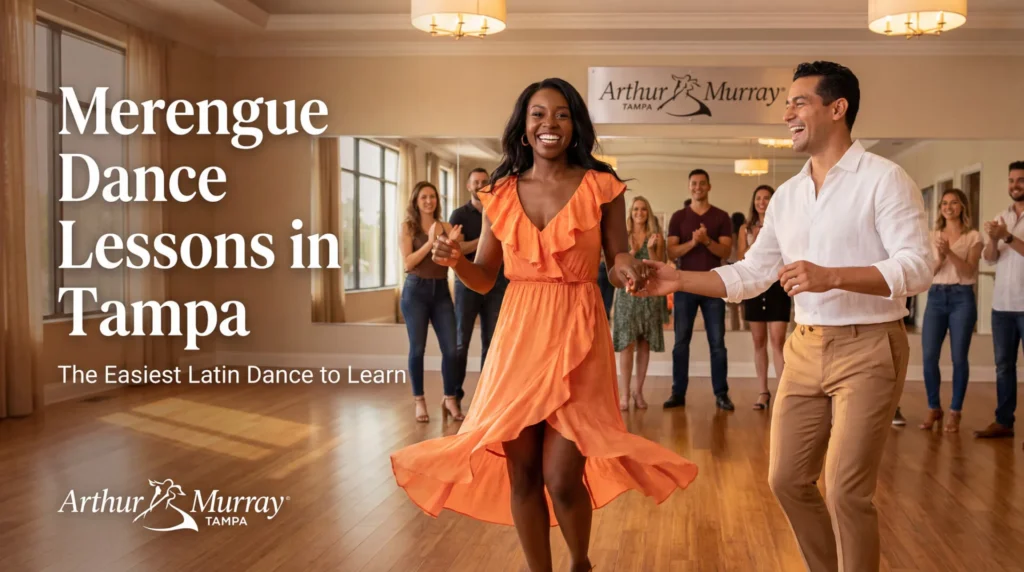
Your first merengue lesson at Arthur Murray Tampa will begin with the basic march step — weight shifting side to side or in place with the music — and the foundational partner hold. Within that first lesson you’ll develop the hip action that is the defining visual quality of merengue, learn to navigate the floor with your partner, and likely add one or two simple turn patterns that immediately make the dance look and feel like something real.
Private lessons in merengue allow your instructor to work specifically on your hip action technique, which is the detail that most dramatically improves the appearance and feel of the dance as it develops. Cuban motion — the hip movement that results from the way Latin dances use the knees and transfer weight — is not something most students develop naturally without specific coaching, and getting it right early in merengue lessons establishes a physical habit that improves every Latin style you learn afterward.
Group classes bring the social dimension that makes Latin dancing so rewarding. Dancing merengue with multiple partners in a group setting builds adaptability and confidence on the social dance floor, which is ultimately where these skills are meant to be used. Tampa has active Latin social events where merengue appears regularly, and the combination of private instruction and group class experience at Arthur Murray Tampa prepares students for those settings in a way that either format alone doesn’t quite replicate.
Frequently Asked Questions
Is merengue really the easiest Latin dance to learn?
For most beginners, yes. Merengue’s rhythm steps on every beat of the music, which removes the syncopation challenge that makes salsa and cha-cha initially frustrating. The foundational step pattern aligns with natural bilateral movement, meaning most students execute a recognizable basic within their first lesson. Advanced merengue has significant depth, but the entry point is lower than any other Latin partner dance.
Can I learn merengue if I have no sense of rhythm?
Merengue is one of the best dances for students who believe they have rhythm challenges, precisely because its beat is so direct and insistent. The music essentially guides the body into the right timing. Most students who arrive convinced they have no rhythm discover in a merengue lesson that the problem was never rhythm — it was familiarity with how to respond to it.
What is the difference between merengue and salsa?
Merengue steps on every beat with an even, alternating weight shift and is danced in close partner connection. Salsa has a syncopated three-step pattern across four beats, uses more open partner positions, and involves more complex turn patterns. Merengue is generally more accessible for beginners; salsa has a steeper initial learning curve but similar depth at advanced levels.
How long does it take to feel comfortable dancing merengue socially?
Most students with consistent instruction can dance merengue comfortably in a social setting within four to eight lessons. The basic skills needed for a real-world dance floor — solid timing, partner connection, simple turns, and basic navigation — come faster in merengue than in almost any other partner dance style.
Is merengue danced at Latin events in Tampa?
Yes. Merengue is a regular feature at Latin social nights, studio events, and celebrations across Tampa. It often alternates with salsa and bachata throughout the evening, and knowing all three gives social Latin dancers full coverage of what a typical Latin event playlist offers.
Do I need a partner to take merengue lessons at Arthur Murray Tampa?
No. Solo students are fully accommodated in both private lessons and group classes. Instructors partner with individual students during private instruction, and group classes rotate partners so everyone gains experience with different leads and follows.
The Dance That Gets You Dancing
Merengue’s reputation as the beginner’s Latin dance is earned, but it undersells what the dance actually is. It’s not a stepping stone you leave behind once you’ve graduated to something more complicated. It’s a fully developed partner dance with its own rich musical tradition, its own technique, and its own unique capacity for joy on the dance floor. The fact that it’s accessible to complete beginners is a feature of how it was built, not a limitation of what it can become.
For anyone in Tampa who has wanted to try Latin dancing but hesitated because the learning curve seemed too steep, merengue is the answer to that hesitation. It doesn’t ask you to be ready before you start. It meets you exactly where you are and shows you what dancing feels like before it asks you to work for it.
Arthur Murray Tampa offers merengue instruction through both private lessons and group classes, and the introductory lesson is free. If Latin dancing has been on your list and you’ve been looking for the right place to begin, you just found it.