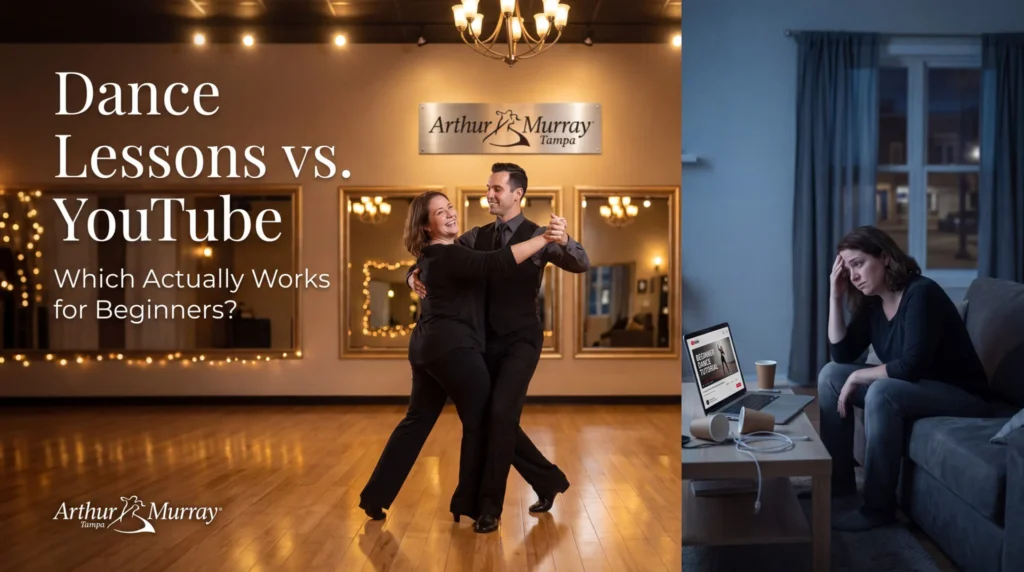
It’s a reasonable question and an honest one. YouTube has tutorials for everything now, and dance is no exception. You can find free videos covering salsa basics, waltz fundamentals, bachata timing, foxtrot footwork — virtually every style taught at Arthur Murray Tampa exists somewhere on the internet in instructional video form, produced by people who clearly know what they’re doing. So why pay for lessons? Why drive to a studio? Why not just learn at home on your own schedule?
These are questions worth answering directly, without the kind of reflexive defensiveness you’d expect from a dance studio. The honest answer is more nuanced than “YouTube is useless” — because it isn’t — and more decisive than “it depends” — because for partner dancing specifically, it really doesn’t.
What YouTube Does Well
YouTube is genuinely good at a few things in the context of dance education, and it’s worth acknowledging them before explaining why they’re not enough.
It’s excellent for exposure. If you want to see what the hustle looks like, understand the difference between bachata and salsa before your first lesson, or watch a demonstration of foxtrot footwork before trying it yourself, YouTube is a fast and useful resource. Visual exposure to what a dance looks like at a competent level gives beginners a mental model to aim at, and there’s nothing wrong with using free video content for that purpose.
It’s also useful for supplementing structured instruction once you already have a foundation. Students at Arthur Murray Tampa who are working on a specific pattern or technique sometimes find it helpful to watch a demonstration between lessons — not to replace what their instructor is teaching them, but to reinforce it. Used that way, online video is a legitimate practice tool.
And for solo movement styles — hip-hop choreography, freestyle, certain fitness-oriented dance formats — YouTube instruction works reasonably well because the learner only has to manage their own body. There’s no partner involved, no lead-follow dynamic, no physical feedback loop. A well-produced tutorial and a mirror can get a motivated solo learner surprisingly far.
The problem is that partner dancing is not a solo activity, and the moment you introduce a second person into the equation, almost everything that makes YouTube instruction functional breaks down.
The Fundamental Problem With Learning Partner Dancing From a Screen
When you watch a dance tutorial on YouTube, you are observing movement from a fixed external perspective. You can see what the instructor’s feet are doing. You can roughly understand the timing. You can follow along in your living room and produce something that looks approximately like what’s on the screen — at least to yourself, in the moment, without a partner.
What you cannot get from a screen is feedback. And in partner dancing, feedback is not a supplement to instruction — it is the instruction.
The most critical skills in any partner dance are not footwork patterns. They’re the physical communication between two people:
- The quality of the lead
- The sensitivity of the follow
- The shared weight and timing that makes two bodies move as one rather than two people executing adjacent solos
These skills don’t exist in isolation. They only exist in the contact between partners, in the moment, in motion. You cannot develop them by watching a video. You cannot develop them by practicing alone. You can only develop them by dancing with someone who knows what correct feels like and can help you find it.
This is the gap that no amount of YouTube content can close, regardless of production quality or instructor credentials. A video can show you what to do. It cannot tell you whether you’re actually doing it, and in partner dancing those are completely different things.
What Happens to Self-Taught Dancers in a Real Partner Situation
Students who spend significant time learning from online tutorials before taking their first in-person lesson follow a remarkably consistent pattern, and instructors at Arthur Murray Tampa recognize it immediately. They know the vocabulary. They can describe what a cross-body lead is. They’ve watched enough video to have strong opinions about technique. And when they actually partner with another person, almost none of it works the way they expected.
This isn’t a failure of intelligence or effort. It’s the predictable result of practicing a partner skill without a partner. The habits that develop in solo tutorial practice are often harder to correct than the habits of a complete beginner who hasn’t yet formed any patterns at all. Common issues include:
- Over-leading with the arms instead of the body
- Anticipating patterns rather than signaling them
- Following based on memory rather than feel
Instructors have a word for this: grooved. A self-taught dancer who has grooved incorrect mechanics over dozens of hours of solo practice requires more corrective work than someone who walks in knowing nothing.
None of this means you wasted your time watching tutorials. It means you hit the ceiling of what screen-based instruction can do for you, which is actually a useful place to arrive — because it means you already know something about the dance and you’re ready to learn it properly.
The Feedback Loop That Changes Everything
What a qualified instructor at Arthur Murray Tampa provides that no video ever can is a real-time, physically responsive feedback loop. When your frame is collapsing, they feel it and correct it in the moment. When your timing is slightly off, they hear it and redirect you before the pattern becomes habitual. When your lead isn’t communicating clearly enough for your partner to follow, they can tell you exactly what signal is missing and help you find it in your body rather than just describing it in words.
This kind of correction is not about being told you’re wrong. It’s about having someone who can feel what’s happening from inside the partnership — as your actual dance partner — and guide the physical experience toward what correct actually feels like rather than what it looks like from the outside. That distinction matters enormously in a skill that lives in sensation and connection rather than in visible shapes.
There’s also the motivational dimension, which matters more than most beginners expect. A private lesson at Arthur Murray Tampa has a human being in the room whose entire purpose for that hour is your progress. They remember where you were last week. They know where you’re headed. They adjust when you’re struggling and push when you’re ready. YouTube has an algorithm that serves you the next video regardless of whether you’re actually improving, and it has never once noticed when a student was about to give up.
The Real Cost Comparison
The most common argument for YouTube over lessons is cost, and it deserves an honest response rather than a dismissal.
YouTube is free, and professional dance instruction is not. That’s a real difference. But the relevant cost comparison isn’t between zero dollars and lesson fees — it’s between the outcome you get from each investment of time and money. Spending thirty hours watching tutorials and developing mechanics that an instructor will spend your first several paid lessons correcting is not actually the free option when you account for the time you spent and the corrective work required afterward. It’s a longer, more expensive path to the same destination, dressed up as a shortcut.
The students who make the fastest, most enjoyable progress at Arthur Murray Tampa are consistently the ones who start with structured instruction from lesson one — not because they’re more talented, but because they’re building on a correct foundation from the beginning rather than repairing a self-taught one. The introductory lesson is free, which means the cost barrier to starting properly is actually zero. Everything after that is an investment in a skill that compounds, not a recurring fee for something you could get elsewhere for nothing.
Where Online Resources Fit Alongside Professional Instruction
This isn’t an argument that YouTube has no place in a dancer’s life. It’s an argument that it has the wrong place when used as a primary learning tool for partner dancing. Used correctly — as a visual reference, a between-lesson reinforcement tool, a way to explore styles before committing to them — online content is a legitimate supplement to structured instruction. Most Arthur Murray Tampa instructors will point students toward specific videos or channels when they’re useful for reinforcing what’s being taught in the studio.
The distinction that matters is this: YouTube is a resource. A qualified instructor with a progressive curriculum and the ability to feel what you’re doing and correct it in real time is something categorically different. Treating them as equivalent alternatives to the same goal is the mistake that keeps a lot of people spinning in place — motivated, well-informed about dance, and not actually improving.
Frequently Asked Questions
Can you actually learn to dance from YouTube?
For solo dance styles — freestyle, certain hip-hop formats, fitness-based dance — YouTube instruction can take a self-motivated learner reasonably far. For partner dancing, the absence of physical feedback and a real partner means the most critical skills simply cannot be developed from a screen, regardless of how good the tutorial is.
I’ve watched a lot of tutorials already. Will that hurt me in lessons?
Not necessarily, and the vocabulary and visual understanding you’ve built has genuine value. The main thing instructors watch for in self-taught students is grooved mechanics — habits formed through solo practice that need to be corrected before building on them. Your instructor at Arthur Murray Tampa will identify these quickly and work with you on them. Starting with some knowledge is usually better than starting with none.
How much do dance lessons cost compared to free online tutorials?
Arthur Murray Tampa’s introductory lesson is free, so the initial cost barrier is zero. Ongoing lesson fees vary by program. The more useful comparison is between outcomes: structured instruction with qualified feedback produces faster, more durable results than self-directed tutorial learning, which means the per-hour cost of actual progress is often lower with professional instruction than it appears on the surface.
What if I want to use YouTube to practice between lessons?
That’s a legitimate and useful approach once your instructor has given you specific material to reinforce. The key is using video to supplement what you’re already building in the studio, not to substitute for it. Your instructor can point you toward resources that reinforce rather than contradict what they’re teaching you.
Is in-person instruction better than online dance courses?
Online dance courses offered by professional instructors — structured, progressive, curriculum-based — are a step up from free tutorial browsing, but they still cannot replicate the physical feedback of in-person instruction for partner dancing. The in-person dimension isn’t a convenience feature. It’s where the most important learning actually happens.
The Bottom Line on Both Sides of This Question
YouTube is a remarkable resource and a genuinely useful tool in a dancer’s life. It is not a substitute for professional instruction in partner dancing, and the gap between the two is not primarily about cost or convenience — it’s about the fundamental nature of what partner dancing requires. Connection, feedback, correction, and the physical experience of what correct feels like are things that happen between people in a room, and no screen-based alternative has found a way around that yet.
Arthur Murray Tampa’s introductory lesson is free, takes about an hour, and will show you more about how partner dancing actually works than thirty hours of tutorials ever could. If you’ve been watching videos and wondering why it isn’t clicking the way you expected, that’s your answer — and the solution is one conversation and one lesson away.