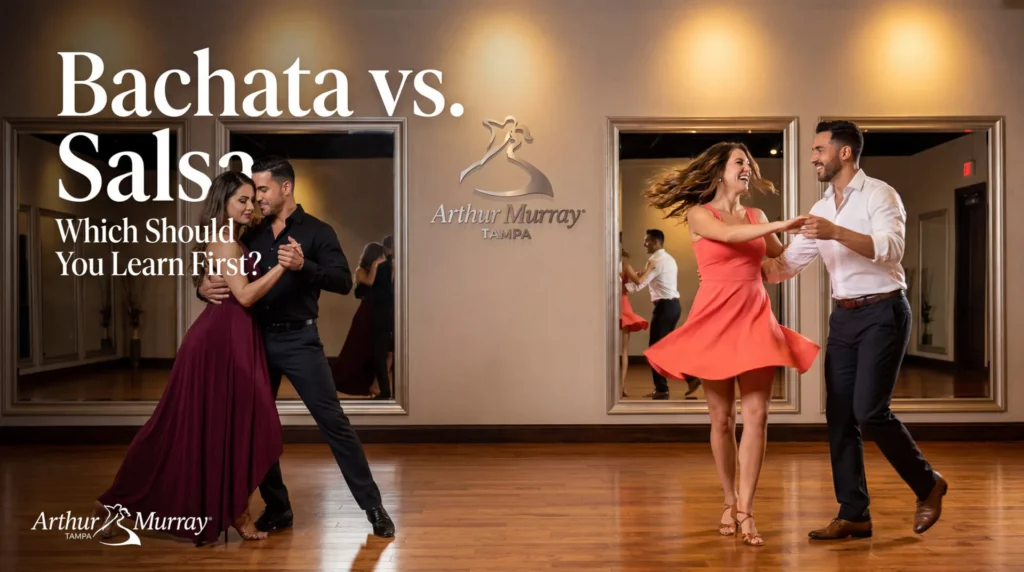
If you’ve decided you want to learn Latin dancing in Tampa, the next question comes almost immediately: bachata or salsa? Both are electric. Both are social. Both are exactly what you picture when you think about Latin partner dancing. And if you ask two different people which one to learn first, you’ll likely get two completely different answers delivered with equal conviction.
The honest answer is that neither dance is universally better for beginners — but one of them is almost certainly better for you, depending on how you move, what kind of music you respond to, and what you’re hoping to do with the skill once you have it. This article is going to give you the clearest possible breakdown so you can walk into your first lesson at Arthur Murray Tampa knowing exactly where you want to start.
The Core Difference Between Bachata and Salsa
Before getting into which is easier or more fun to learn, it helps to understand what actually separates these two dances at a foundational level, because the differences are more meaningful than most beginners expect.
Salsa is built on urgency. The music is fast, syncopated, and layered — Afro-Cuban rhythms with brass, percussion, and a tempo that demands you commit. The basic step pattern runs on an eight-count with three weight changes and a tap, and the dance itself tends to involve a lot of turns, spins, and footwork that travels across the floor. When salsa looks the way salsa looks in your imagination — fast, flashy, full of spinning energy — that’s because the music essentially requires it. The rhythm is assertive and the dancer has to respond in kind.
Bachata is built on intimacy. It comes from the Dominican Republic and its musical DNA is entirely different — slower, melodic, with a guitar-led sound and a distinctly emotional quality that salsa doesn’t share. The basic step runs left-right-left-tap, right-left-right-tap with a hip accent on the tap, and the dance keeps partners in much closer connection than salsa typically does. Where salsa uses space and speed to create excitement, bachata uses proximity and feeling. The two dances sit at different ends of the Latin dance emotional spectrum, and that difference matters when you’re choosing where to begin.
Which One Is Easier to Learn?
This is where most comparison articles give you a frustratingly vague answer. Here’s a more useful one: bachata has a lower floor and salsa has a higher ceiling, which means bachata is generally easier to get started with, but salsa offers more to pursue over time.
Bachata’s basic step is genuinely one of the most accessible in all of partner dancing. The rhythm is slower and more forgiving, the music’s emotional quality helps beginners feel the beat instinctively, and the close connection between partners means there’s more physical communication to lean on when your footwork isn’t quite right yet. Most beginners can execute a recognizable bachata basic within their first lesson and feel something resembling actual dancing by their second or third. That early sense of success is powerful, and it keeps people coming back.
Salsa’s basic step isn’t dramatically harder on paper, but the tempo changes everything. The music moves faster, the window for hitting the beat is narrower, and the turns and patterns that make salsa look the way it looks require a level of coordination and timing that takes more lessons to develop. Beginners who start with salsa often spend more time in the frustration phase before the breakthrough comes — which isn’t a reason to avoid it, but it’s worth knowing going in.
That said, the gap between bachata and salsa in terms of difficulty is not as wide as some people make it sound. Tampa has active social dance scenes for both styles, and students at Arthur Murray who commit to either one consistently make real progress within the first month.
The Rhythm Question
One of the most practical ways to choose between bachata and salsa is to pay attention to which music makes your body want to move before you’ve learned a single step.
Put on a salsa track — something with Celia Cruz or Marc Anthony — and notice what happens physically. Does the rhythm feel exciting and energizing? Does it make you want to move fast? Or does it feel slightly chaotic and hard to locate a pulse in? Now put on a bachata track — Romeo Santos, Prince Royce, or Aventura work well — and ask the same questions. Is the beat easier to feel? Does the emotional quality of the music resonate with you?
The dance you can feel most naturally in the music before you’ve learned the steps is almost always the dance you’ll pick up fastest. Your body already knows something about that rhythm — your lessons are just teaching it to respond in a more organized way.
This isn’t a perfect formula, but it’s a better starting point than flipping a coin, and instructors at Arthur Murray Tampa will often play both styles in an introductory session for exactly this reason.
Social Dancing in Tampa: Where Can You Use Each One?
Part of choosing between bachata and salsa is thinking about what you’ll actually do with the skill once you have it. Tampa has a genuine Latin dance social scene, and the two styles show up in different contexts.
Salsa has been a fixture at Tampa venues and events for years. Latin nights at clubs around the city, studio social nights, and community events regularly feature salsa as the dominant style. If your goal is to walk into a Latin club in Tampa and be able to dance with whoever asks, salsa fluency is going to serve you more broadly in that specific setting.
Bachata has exploded in popularity over the last several years — driven in large part by social media — and it’s now equally present at most Latin social dance events. In many venues, bachata and salsa alternate throughout the night, and the ability to do both confidently is the real gold standard for social Latin dancers. But if you’re starting from zero, bachata’s rise in popularity means you won’t lack for opportunities to use it. The days of bachata being the secondary style at a salsa night are largely over.
For couples specifically, bachata tends to create a more immediate sense of connection on the social dance floor, which is why many couples who come to Arthur Murray Tampa for a date night or as a joint project often find bachata becomes their first love even if salsa was what they originally wanted to learn.
What If You Want to Learn Both?
Most students who get serious about Latin dancing in Tampa end up learning both, and that’s not just an upsell — it’s genuinely how the social dance world works. The two styles complement each other more than they compete.
- Students who understand salsa’s timing and turn patterns find that bachata’s slower pace gives them space to refine their lead and follow skills with less pressure.
- Students who start with bachata and develop strong hip action and partner connection find that those qualities translate directly into better salsa.
The practical question isn’t really bachata or salsa — it’s which one first. And the answer to that comes back to what the music does to you, how patient you are with the early frustration curve, and what you’re hoping to do with it socially. Once you’ve answered those questions honestly, the choice usually makes itself.
Your instructor at Arthur Murray Tampa will help you figure this out in your very first lesson, often within the first fifteen minutes. The introductory lesson is specifically designed to explore where you naturally respond and what’s going to give you the fastest, most satisfying start — and that’s a better diagnostic than anything you’ll read in an article.
Frequently Asked Questions
Is bachata easier than salsa for complete beginners?
Generally, yes. Bachata’s slower tempo and more accessible rhythm make it easier to feel the beat and execute the basic step in early lessons. Salsa’s faster pace and syncopated timing create a steeper initial learning curve, though neither dance is truly difficult with consistent instruction.
Can I learn bachata and salsa at the same time?
You can, though most instructors recommend building a solid foundation in one before introducing the other. Trying to learn both simultaneously in the very early stages can create confusion between the two rhythms and step patterns. Once your foundational timing is stable in one style, adding the second comes much faster.
Which Latin dance is more popular in Tampa right now?
Both are active in Tampa’s social dance scene. Salsa has a longer local history, but bachata has grown dramatically in popularity over the last three to five years and is now equally present at most Latin social events. Knowing both gives you the most flexibility on any dance floor in the city.
What’s the main physical difference between bachata and salsa?
Bachata is danced in a closer, more connected partner embrace with a lateral step pattern and a hip accent on the fourth count. Salsa uses more space, involves more turns and travel across the floor, and has a faster, more complex rhythmic structure. Bachata emphasizes connection; salsa emphasizes energy and musicality.
Do I need a partner to start Latin dance classes in Tampa?
No. Most students at Arthur Murray Tampa begin as individuals. Instructors serve as your partner during private lessons, and group classes rotate partners so you gain experience with multiple people. Having a partner can be fun, but it is absolutely not a requirement to get started.
Which dance is better for couples?
Both work beautifully for couples, but bachata often creates a more immediate sense of physical connection because of the close embrace and slower pace. Many couples find it the more naturally romantic starting point. Salsa builds connection through shared energy, timing, and the excitement of executing turns together. Most couples eventually love both.
The Bottom Line
Bachata and salsa are two of the most rewarding dances you can learn, and the choice between them is much less consequential than the decision to start. Both will put you on Tampa’s social dance floors. Both will challenge you and surprise you. Both will give you something to look forward to every week.
If the music pulls you one direction, trust that. If you genuinely can’t decide, come in for an introductory lesson at Arthur Murray Tampa and let your body make the call. It usually knows before your brain does.