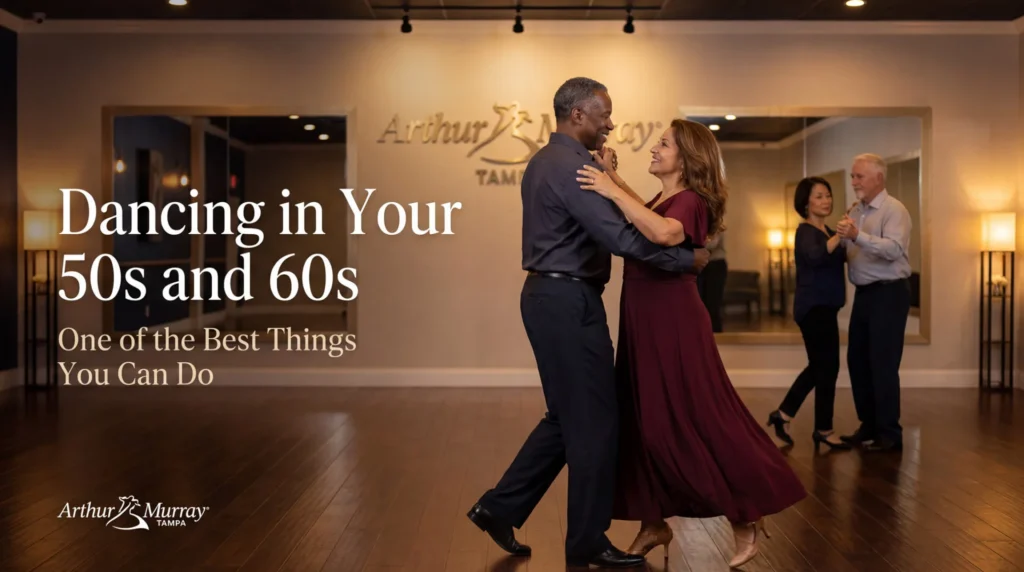
At some point in their fifties or sixties, a lot of people quietly revise their sense of what’s still available to them. Not consciously, and not all at once, but gradually — the assumption that certain activities belong to younger bodies, that the window for learning new physical skills has more or less closed, that the time for trying something genuinely new has passed. It’s a natural drift, and it’s almost entirely wrong.
Ballroom dancing doesn’t just tolerate older adults. In many ways, it’s designed for them — and the research on what it does for people in their fifties, sixties, and beyond is specific enough and consistent enough that it deserves to be taken seriously rather than filed under feel-good wellness content. This article is going to make the case plainly, because the people who most need to read it are often the least likely to walk through the door without one.
The Body Benefits Are Real and Specific
The physical case for ballroom dancing in later life isn’t built on generalities about staying active. It’s built on what this specific activity does to the body that most other activities don’t.
Balance is the starting point. Falls are the leading cause of injury-related death among adults over 65 in the United States, and the physical mechanism behind most falls is deteriorating balance and postural control — a gradual loss of the body’s ability to make the micro-adjustments that keep it upright under changing conditions. Ballroom dancing directly trains the neuromuscular systems responsible for balance in ways that walking, cycling, or even most gym-based exercise programs don’t. The constant weight shifting, the lateral movement, the partner connection that requires you to sense and respond to another body’s momentum — all of it is active balance training happening in an enjoyable context. Studies comparing balance outcomes in older adults who danced versus those who did conventional exercise programs consistently show advantages for the dancers.
Cardiovascular health responds to dancing in ways that surprise people who expect it to be gentle. A moderate-tempo ballroom session — foxtrot, cha-cha, salsa — maintains heart rate in the aerobic zone for extended periods without the joint stress of running or high-impact exercise. For adults in their fifties and sixties who need cardiovascular conditioning but whose knees, hips, or backs have made high-impact exercise uncomfortable or inadvisable, ballroom dancing is one of the most effective available alternatives. It delivers cardiovascular benefit on a forgiving surface, with movement that is smooth and controlled rather than percussive.
Muscle engagement in ballroom dancing is more comprehensive than it looks from the outside. The core is constantly active in maintaining frame and posture. The legs are working through the continuous weight transfer and directional changes. The arms and shoulders maintain connection with a partner throughout the dance. And because the body is moving in multiple planes and directions rather than the single plane of most gym-based exercise, the smaller stabilizing muscles that are so important for functional mobility get worked in ways that bilateral exercises on machines never reach.
Flexibility improves gradually and sustainably through the natural range of motion that ballroom movement requires. This is not the aggressive flexibility training of yoga or stretching programs — it’s functional flexibility, the kind that makes getting in and out of a car easier, that makes reaching and bending less effortful, that preserves the everyday mobility that people in their sixties and seventies increasingly realize they cannot take for granted.
What Dancing Does for the Brain
The cognitive case for ballroom dancing in later life is where the research gets genuinely striking, and it’s worth spending real time on because it’s not widely understood outside of academic circles.
A 2003 study published in the New England Journal of Medicine examined leisure activities and their association with dementia risk in adults over 75. Of all the physical activities studied, dancing was the only one associated with a reduced risk of dementia. Not reduced progression — reduced risk. The researchers hypothesized that the cognitive demands of dancing — processing music, coordinating movement, making real-time decisions in response to a partner, navigating a floor — create a kind of neural complexity that other physical activities don’t. Dancing, in other words, is not just exercise for the body. It’s exercise for the brain in a way that running or swimming or cycling simply isn’t.
The mechanism behind this isn’t mysterious. Learning and executing dance patterns requires the simultaneous engagement of multiple cognitive systems: working memory holds the sequence of steps while procedural memory automates the ones already learned. Attention divides between your own movement and your partner’s. Spatial processing maps your position on the floor relative to other couples. Auditory processing tracks the music and extracts timing information in real time. Executive function makes the decisions — which pattern to lead next, how to adapt when your partner’s balance shifts unexpectedly, when to simplify and when to stretch. Very few activities engage all of these systems simultaneously, and the ones that do tend to be the ones associated with the strongest cognitive outcomes in older adults.
What this means practically for someone in their fifties or sixties who is thinking about taking dance lessons at Arthur Murray Tampa is this: every lesson is doing something for your brain that your cardiovascular workout is not. The two activities are complementary, not redundant. And the cognitive engagement of dance increases as the material becomes more complex, which means it scales with your development rather than plateauing the way simpler activities tend to.
The Social Dimension Nobody Talks About Enough
Social isolation is one of the most significant and underappreciated health risks facing adults over 55. Research published over the last decade has placed its health impact on par with smoking fifteen cigarettes a day — a comparison dramatic enough to be worth sitting with. The mechanisms include elevated inflammatory markers, disrupted sleep, increased cortisol, and a gradual erosion of the cognitive stimulation that social contact provides. It is a genuine health problem, not merely an emotional one, and it tends to deepen gradually and quietly in ways that make it hard to recognize from the inside.
Ballroom dancing is, at its core, a social activity. Every lesson involves real human contact — physical connection with a partner, the attentiveness to another person’s movement that partner dancing requires, the conversation with an instructor who knows your name and your history and where you were last week. Group classes at Arthur Murray Tampa add another layer: a community of students at similar stages, sharing similar experiences, navigating the same learning curve with the particular warmth that comes from laughing at the same stumbles.
Students who begin at Arthur Murray Tampa in their fifties and sixties consistently describe the social environment as one of the primary reasons they keep coming back — often equal to or greater than the dancing itself. The studio becomes a standing appointment in the week that is genuinely looked forward to, a commitment to showing up and being present in a room full of people who are glad you’re there. For adults whose social networks have contracted through retirement, relocation, or the natural attrition of aging, that kind of weekly structure and human connection is not trivial. It is, for some students, transformative.
The Question of Whether It’s Too Late
This is the question that keeps more people from starting than any other, and it deserves a direct answer.
It is not too late. That’s not encouragement — it’s a factual description of how adult learning and physical development work. The human body’s capacity to develop new motor skills, build new neural pathways, and improve coordination, balance, and strength does not disappear in the fifties and sixties. It changes — the learning curve is somewhat longer than it might have been at twenty-five, and the body recovers more slowly between sessions — but the capacity is there, and the outcomes are real.
Arthur Murray Tampa works with adult students across a wide age range, and the instructors who work with older beginners are consistently specific about what they observe: students in their fifties and sixties tend to be more patient with the process, more committed to showing up consistently, more genuinely curious about understanding the technique rather than just executing the pattern, and more appreciative of the incremental progress that younger students sometimes take for granted. These qualities make older beginners, in many respects, better students. The learning may take longer in some areas, but the foundation it builds tends to be more durable.
What older beginners don’t have is the luxury of wasting time on the wrong approach. Starting with qualified instruction, building on a correct foundation from the beginning, and having a structured curriculum that progresses deliberately rather than randomly — these things matter at any age, but they matter more when efficiency is a genuine consideration. Arthur Murray Tampa’s method was built around exactly these principles, which is part of why it has worked for students of every age and background for over a century.
Which Styles Work Best for Beginners Over 50
The honest answer is that this varies more by individual than by age, and the introductory lesson at Arthur Murray Tampa is specifically designed to assess what style will give each student the best starting experience. That said, a few patterns emerge consistently enough to be worth knowing.
Foxtrot is one of the most popular starting points for older adult beginners, and for good reason. Its smooth, walking-based movement is natural to the body, its rhythm is accessible, and it translates directly to social dancing situations — wedding receptions, cruises, events — that are already part of many students’ lives. There is no steep initial awkwardness with foxtrot the way there can be with faster Latin styles. It feels elegant from fairly early in the learning process, which is motivating.
Waltz appeals strongly to students who are drawn to the romantic, sweeping quality of classic ballroom dancing. Its three-beat rhythm is one of the most universally recognized in music, and the rise and fall of the waltz creates a physical sensation that students often describe as uniquely satisfying — a feeling of genuine dancing that arrives earlier in the learning process than in many other styles.
Rumba is the most popular Latin starting point for older adult couples, specifically because its slower tempo and emphasis on connection and expression suit a more deliberate, communicative style of dancing. The hip action of rumba develops with practice rather than arriving fully formed, which means it rewards consistency rather than demanding immediate physical flexibility.
Whatever style you start with, the structure of instruction at Arthur Murray Tampa ensures it builds progressively on itself. You are not starting over with each new style. The balance, timing, partner connection, and body awareness you develop in one dance carry forward into every dance that follows.
The Window Is Not Closed
There is a version of your fifties and sixties that includes something you built yourself — a skill that lives in your body, a community you belong to, a standing appointment every week that you genuinely look forward to. A version where your balance is better than it was five years ago instead of worse. Where your brain is more engaged, not less. Where you share something with your partner, or discover something about yourself as a solo student, that reframes what this chapter of life can hold.
That version is available. It starts with a free introductory lesson at Arthur Murray Tampa, an hour of your time, and the decision to find out what’s still possible. Most people who make that decision are surprised by the answer.
Frequently Asked Questions
Is ballroom dancing safe for people in their 60s with joint issues?
For most joint conditions, ballroom dancing is not only safe but beneficial. The smooth, non-percussive nature of most ballroom styles puts significantly less stress on knees and hips than running or high-impact exercise. Students with specific concerns should consult their physician before beginning, and instructors at Arthur Murray Tampa can adapt movement to accommodate physical limitations. Most students with joint issues find that dancing over time actually improves the strength and stability around the affected joints.
Do I need a partner to start dancing in my 50s or 60s?
No. The majority of adult students at Arthur Murray Tampa begin as individuals. Instructors serve as your partner during private lessons, and group classes rotate partners throughout the session. Many solo students who begin in their fifties or sixties develop a full social dancing life through the studio community without ever having enrolled with a partner.
Will I be behind everyone else in group classes?
Group classes at Arthur Murray Tampa are structured by level, not age. Beginner classes contain students at similar stages of development regardless of how old they are. The studio culture is genuinely non-competitive and supportive, and the experience of being in a room with other adults navigating the same learning curve is typically more comfortable than beginners expect.
How often should older adults take lessons to see real progress?
Once a week is the standard recommendation and works well for most students in this age range. Some students find that slightly more frequent lessons early in the process — twice a week for the first month — helps establish momentum and prevents material from fading between sessions. Your instructor will help you find the right cadence based on your learning pace and schedule.
What does ballroom dancing do for cognitive health specifically?
Research suggests that the combination of physical movement, musicality, social engagement, and real-time decision-making in partner dancing produces cognitive benefits that simpler physical activities don’t. Studies have associated regular dancing with reduced dementia risk, improved memory, and better executive function in older adults. The mechanism is the simultaneous engagement of multiple cognitive systems — motor, auditory, spatial, social — that most activities don’t require at the same time.
Is Arthur Murray Tampa welcoming to older adult beginners?
Consistently and genuinely, yes. The studio’s culture reflects over a century of working with students of every age and background, and the instructors who work with older adult beginners bring both technical skill and the particular patience and attentiveness that this demographic benefits from. Reviews from older adult students at Arthur Murray Tampa describe it as one of the most welcoming environments they’ve encountered for trying something new later in life.
The Window Is Not Closed
Discover what’s still possible in your fifties, sixties, and beyond. Start with a free introductory lesson and find out how much your body and mind can still learn.
Free introductory lesson · No partner required · Welcoming to beginners of every age · Tampa (Hyde Park)