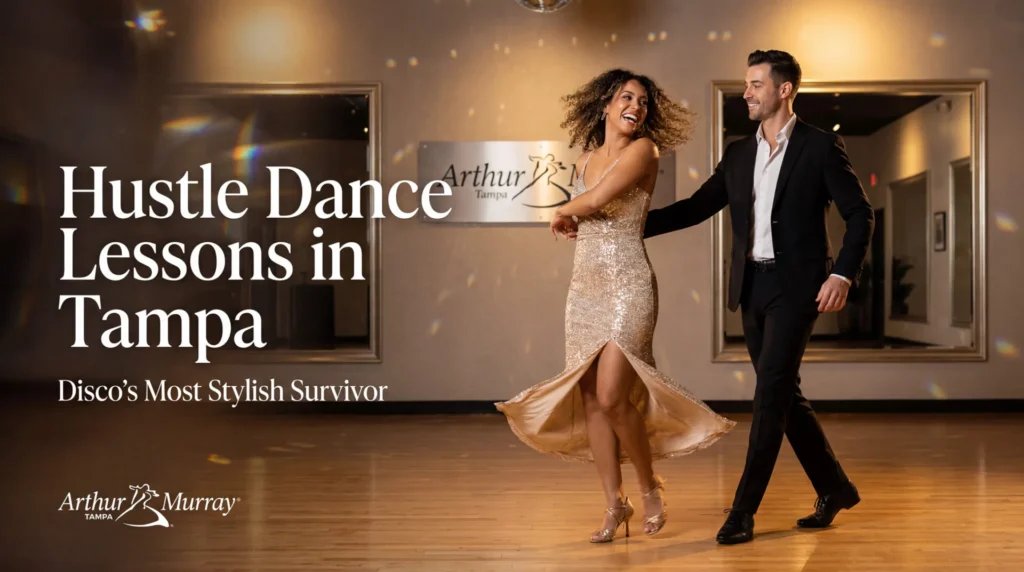
Most dances from the 1970s didn’t make it. The era produced plenty of novelty moves that belonged entirely to their moment — things you do now only at themed parties, with full ironic awareness, surrounded by people who find it as amusing as you do. The hustle is not one of those dances. It survived the decade that created it, outlasted every obituary written about disco, and is still being taught in ballroom studios across the country because it turns out the hustle is just genuinely, durably good.
If you’ve never considered hustle dance lessons, it’s probably because nobody positioned it correctly to you. This article is going to fix that.
What the Hustle Actually Is
The hustle is a partner dance that emerged from the New York club scene in the mid-1970s, reached mainstream consciousness through the 1977 film Saturday Night Fever, and never fully disappeared despite disco’s cultural implosion at the end of that decade. What kept it alive was the same thing that made it popular in the first place: it is an exceptionally fun, technically rich, and visually impressive dance that works on almost any dance floor and to an enormous range of music.
At its core, the hustle is a six-count partner dance built around turns, spins, and a smooth, connected partnership style. The lead moves the follow through a continuous flow of patterns, and the follow’s job involves a level of spin technique and stylistic expression that makes it one of the most satisfying dances to develop as a skill. The footwork is relatively compact — the hustle doesn’t travel across the floor the way waltz or foxtrot does — which makes it practical in social settings where space is limited. And because the timing sits comfortably over a huge range of contemporary music, not just disco, it’s one of the most versatile dances in a social dancer’s repertoire.
What surprises most beginners is how current the hustle looks when it’s danced well. Strip away the bell-bottoms and the mirror ball associations and what you have is a fast, elegant, turn-heavy partner dance with sophisticated lead-follow mechanics and a lot of room for personal style. It doesn’t look dated. It looks polished.
How It Compares to Swing and Salsa
If you’ve looked at Arthur Murray Tampa’s dance offerings and found yourself trying to locate the hustle in relation to styles you already know something about, here’s a useful orientation.
The hustle shares some DNA with East Coast swing in that both are social dances with a strong turn and spin vocabulary and a playful, energetic quality. But where swing is built on a bouncy, rhythmically elastic feel — that characteristic rock-step and triple-step pattern — the hustle is smoother and more continuous. There’s no bounce in the hustle. The movement is sleek, the connection between partners is sustained rather than punctuated, and the whole thing has a kind of cool momentum that swing’s bouncier energy doesn’t quite replicate.
Compared to salsa, the hustle is actually somewhat more approachable for beginners because the timing is cleaner and the basic footwork is simpler to locate in the music. Both dances are turn-heavy and both reward students who invest in spin technique, but salsa’s syncopated rhythm creates more early confusion than the hustle’s more straightforward count structure. Students who have struggled to find the beat in salsa sometimes discover that the hustle’s timing clicks for them much more naturally, which gives them a satisfying Latin-adjacent social dance without the frustration of fighting a faster, more complex rhythm.
None of this is to say the hustle is easy. Like every partner dance worth learning, it has layers — and the students who go deep on hustle technique develop a spinning fluency and a connected, sophisticated lead-follow quality that carries over into nearly everything else they dance.
The Music Question
One of the practical advantages of learning the hustle in Tampa right now is the sheer range of music it works over. Yes, it was built for disco — and if you put on Earth, Wind & Fire or Donna Summer, a well-danced hustle is an almost perfect match. But the timing and feel of the hustle also sits comfortably over contemporary pop, R&B, funk, and even certain hip-hop tracks. It is not a museum piece that only works when someone deliberately cues the decade-appropriate soundtrack.
This matters for social dancers because it means the hustle is a live option at events that aren’t specifically Latin nights or swing events. A Tampa wedding reception, a corporate party, a friend’s backyard celebration — anywhere the DJ is playing something upbeat and contemporary, a couple who knows the hustle can find the beat and look genuinely impressive doing it. That kind of versatility is worth something.
For students at Arthur Murray Tampa who are building a social dance toolkit rather than specializing in one style, the hustle is one of the more strategically useful dances to add early. It fills a gap that neither swing nor salsa quite covers, and its music compatibility means it gets used in real-world settings more frequently than people expect when they first start learning it.
What Hustle Lessons Look Like at Arthur Murray Tampa
Hustle instruction at Arthur Murray Tampa follows the same structured, progressive approach that applies to every dance in the curriculum. You’ll start with the fundamental six-count timing and the basic step pattern — which is accessible enough that most beginners can feel it working within the first lesson — and build from there through turns, cross-body patterns, and eventually the spin technique that makes advanced hustle so satisfying to watch and to do.
The lead-follow mechanics in the hustle are worth particular attention because they’re refined and nuanced in ways that beginners don’t initially appreciate. The connection between partners in a well-danced hustle is continuous and communicative — the lead is constantly signaling direction and momentum, and the follow is constantly interpreting and responding to those signals while executing their own footwork and styling. It’s a genuine two-person conversation happening entirely through physical connection, and developing that sensitivity is one of the things that makes hustle lessons rewarding well beyond the beginner stage.
Your instructor will work with you on spin technique specifically, because turns are such a central feature of the hustle that neglecting them early creates a ceiling that’s frustrating to hit later. Students who build solid single-turn mechanics before moving to double and triple spins develop much more reliably than those who rush the progression, and Arthur Murray Tampa’s curriculum is structured to prevent that shortcut from becoming a habit.
As with all social dances taught at the studio, group classes give you the opportunity to dance the hustle with multiple partners — which is where the adaptability and real-world fluency develop — while private lessons handle the technical refinement that makes the group class experience productive.
Why the Hustle Deserves a Spot in Your Dance Repertoire
Tampa’s social dance scene is rich enough that being a one-dance dancer eventually becomes limiting. Salsa nights, Latin events, studio socials, and general-audience dance events all call for different styles, and the dancers who show up with range — who can move confidently across musical contexts and partner styles — are the ones who have the most fun and get asked to dance the most.
The hustle earns its place in that repertoire not through nostalgia but through genuine utility. It is:
- A technically serious dance that rewards investment
- A socially versatile dance that works across musical contexts
- One of the few partner dances that looks immediately current rather than historically situated when it’s danced at a high level
The disco era gave it its name and its origin story, but the hustle’s longevity comes from its own merits — and fifty years after Saturday Night Fever, those merits are still accumulating students.
Arthur Murray Tampa’s hustle instruction is available through both private lessons and group classes, and the introductory lesson is the fastest way to find out whether this is the dance you’ve been overlooking. Most students who try it for the first time are surprised by how quickly it feels like something. Give it an hour and see what it does to you.
Frequently Asked Questions
Is the hustle hard to learn for beginners?
The hustle’s basic timing and step pattern are accessible to most beginners, and many students find it easier to locate the beat in hustle music than in salsa or swing. The foundational footwork comes relatively quickly. Spin technique takes longer to develop but is introduced progressively, so beginners aren’t asked to execute turns before they have the foundation to do them well.
What kind of music is the hustle danced to?
Disco is the hustle’s natural home, but the timing works comfortably over a wide range of contemporary music including pop, R&B, and funk. This makes it one of the more versatile social dances in terms of where and when you can use it outside of the studio.
How is the hustle different from swing dancing?
Both are social partner dances with strong turn vocabularies, but the hustle is smoother and more continuous where swing is bouncy and rhythmically elastic. The hustle has no bounce or rock-step — the movement is sleek and sustained. The two dances have a different physical feel despite some surface similarities.
Do I need a partner to take hustle lessons?
No. Arthur Murray Tampa accommodates solo students in all dance styles. Instructors partner with you during private lessons, and group classes rotate partners throughout the session so you gain experience dancing with different people.
Is the hustle still danced socially or is it mainly a studio style?
The hustle has a genuine social following, particularly among dancers who came up in studios and built a broad repertoire. It appears regularly at studio social events, and its music versatility means it gets used at general-audience events more than most people expect. It is not a purely competitive or studio-only style.
Can the hustle be danced at a wedding?
Absolutely, and it’s one of its strongest suits. The hustle works beautifully over the kind of upbeat contemporary pop and R&B that appears on most wedding reception playlists. Couples who know the hustle always have a dance for the moments when the DJ plays something that doesn’t fit their salsa or foxtrot.
The Dance That Outlasted Its Decade
There’s something worth respecting about a dance that was supposed to die with its era and just kept going. The hustle didn’t survive on sentiment. It survived because it’s good — technically interesting, socially useful, musically flexible, and deeply satisfying to develop as a skill. Every decade since the 1970s has produced a new generation of dancers who discovered the hustle, expected something retro and campy, and found something genuinely worthwhile instead.
Arthur Murray Tampa offers hustle lessons as part of a full social and ballroom dance curriculum, and if the hustle has been sitting at the edge of your awareness without quite making it onto your list, this is the moment to move it up. Book your introductory lesson and find out why this one made it when so much else from that era didn’t.