What Is the Mambo?
-
The Definition: Mambo is a Cuban-born Latin dance danced to fast, syncopated Afro-Cuban music, and it is also one of the American Rhythm ballroom dances taught in studios today.
-
The Signature Timing: Mambo holds on beat 1 and breaks on beat 2. Ballroom Pages describes the beginner count as 2-3-4-(1), which is the single detail that separates mambo from most other Latin dances.
-
The Salsa Connection: Salsa grew out of mambo. Learning mambo gives you the parent rhythm, the same forward-and-back breaking action, and a clearer ear for where the music actually lands.
-
The Origin: According to American Dancer, mambo began in 1930s Havana when Orestes and Israel “Cachao” López added a fast, syncopated closing section to the formal Danzón.
-
The Learning Path: Small steps first, then timing, then turns. Arthur Murray Tampa teaches Mambo in both private and group formats at the Hyde Park and Clearwater studios, alongside Salsa and Cha Cha.
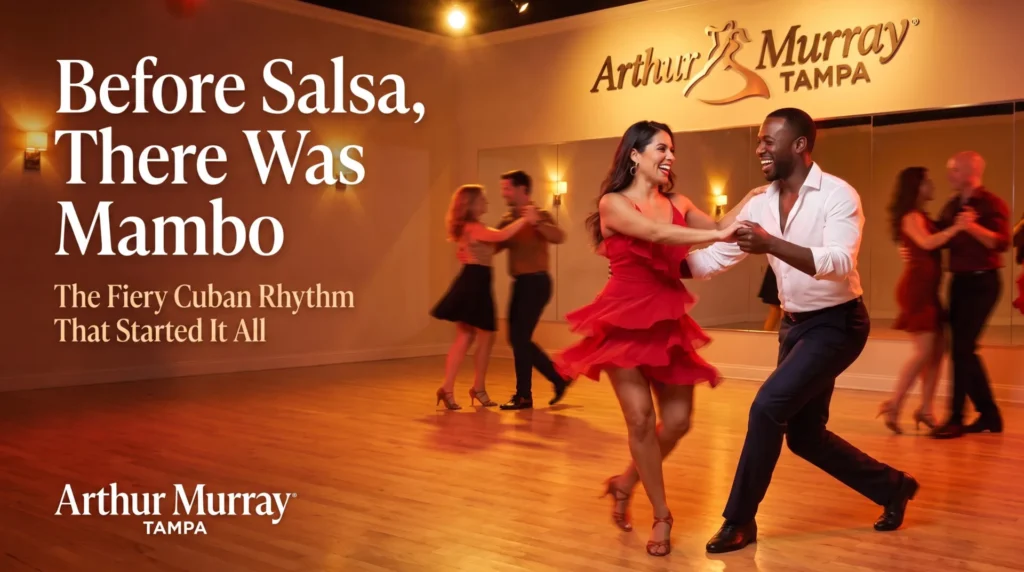
A song comes on at a Tampa social dance night and the floor changes shape. The tempo is quick, the horns punch in on an off-beat, and the couples who know what they are hearing pause for a fraction of a second before they move. They are not late. They are holding beat 1 on purpose, and stepping on beat 2. That pause is the mambo.
Most people meet this rhythm through salsa and never learn that salsa has a parent. Mambo came first, out of Havana, and it carried the two-beat break into New York ballrooms before salsa had a name. If you have ever wondered why some Latin dancers seem to be a half-count behind everyone else, or whether mambo and salsa are the same thing, this article answers both questions.
Below you will find what the mambo actually is, where it came from, how its timing works, how it compares to salsa on the social floor, and what a first lesson looks like for an adult who has never danced a step.
What Is the Mambo Dance, and Where Did It Come From?
The Short Answer:
Mambo is a Cuban Latin dance danced to fast, syncopated Afro-Cuban music, and one of the American Rhythm ballroom dances. American Dancer traces it to 1930s Havana, where Orestes and Israel “Cachao” López added a quick, syncopated closing section to the formal Danzón. The word comes from the Kongo language, generally translated as “conversation with the gods.” Its defining feature is breaking on the second beat.
The Danzón and the Section That Broke Away
Mambo did not arrive as a finished dance. It started as a section inside another one. American Dancer reports that Cuban musicians Orestes and Israel “Cachao” López took the formal Danzón and added a faster, syncopated, high-energy closing passage, which musicians called the mambo section.
That closing passage was the part dancers waited for. It was quicker, looser and more percussive than everything before it, and it eventually outgrew the form that contained it. What began as an ending became a dance of its own.
What the Name Actually Means
The word itself is older than the music. According to American Dancer, mambo comes from the Kongo language and is generally translated as “conversation with the gods” or “prayer.” That is a useful thing to carry onto the floor. The dance has always been about call and response between the music and the body, not about executing shapes.
Milestones in the Mambo Story
-
Havana, 1930s: The López brothers add a syncopated closing section to the Danzón, giving the rhythm its first identity, per American Dancer.
-
The Break Away: Dancers begin treating that closing section as the main event rather than the finish, and the mambo section becomes the mambo.
-
New York Refinement: American Dancer notes that as the dance was refined in New York, the two-beat break — breaking on the 2nd beat of the measure — became the standard timing.
-
Ballroom Adoption: Mambo settles into the American Rhythm family, taught alongside Cha Cha, Rumba and Bolero with a structured beginner-to-advanced progression.
-
The Salsa Era: The same clave-driven rhythm, faster and repackaged, becomes the social dance most Americans now call salsa — with mambo sitting underneath it.
Why the Two-Beat Break Matters So Much
Most beginners assume every dance starts on beat 1, because that is how counting works everywhere else in life. Mambo does not. You hold on 1 and step on 2, which means your first movement lands where the music has already begun to push.
This is why mambo sounds different even when the song is the same. The break falls on the accented beat rather than the downbeat, so the dance sits inside the percussion rather than on top of it. Once your ear finds that, the timing stops feeling backwards and starts feeling obvious.
Where Mambo Sits Among the Latin Dances
Mambo is part of a family, and hearing the family resemblance speeds up everything. Cha Cha shares mambo’s break-and-replace action with a triple step added. Rumba slows the same body mechanics down. Bolero stretches them further still, and Samba and Merengue bring in different rhythms entirely.
Students at our Latin dance classes in Tampa usually find that their second Latin dance takes far less time than their first, because the underlying rhythm work transfers. That is the practical argument for learning mambo rather than skipping it.
Mambo vs Salsa: How Do They Differ, and How Do You Learn Either One?
The Short Answer:
Salsa descends from mambo and shares its Afro-Cuban rhythm, but the two differ in timing and feel. Ballroom Pages describes the mambo beginner count as 2-3-4-(1) — hold on 1, break on 2 — while most social salsa in Tampa breaks on beat 1. Mambo also carries a ballroom lineage as an American Rhythm dance. Learn either with small steps and timing before speed.
The Honest Answer on the Difference
Salsa and mambo are close relatives rather than opposites. They use the same musical family, the same quick-quick-slow rhythmic idea and much of the same partnering. The clearest working difference is where the break lands: mambo breaks on 2, and most social salsa danced in Tampa breaks on 1.
Ask ten dancers and you will get variations on that answer, because the line has blurred over decades of social dancing. What does not blur is the ballroom side. Mambo is one of the American Rhythm dances, which means it has a defined syllabus, a competitive form and a structured progression that salsa’s social scene does not formalise in the same way.
Mambo and Salsa Compared
-
Timing: Mambo holds on 1 and breaks on 2, per Ballroom Pages. Most social salsa in the Tampa Bay area breaks on 1, which is why the two look offset on the same song.
-
Feel: Mambo carries a sharper, more percussive attack. Salsa tends to run more continuously, with the turn patterns flowing one into the next.
-
Setting: Mambo appears in ballroom showcases and American Rhythm competition. Salsa dominates the social club floor and Latin nights.
-
Learning Order: Neither has to come first. Learning mambo first tends to sharpen your timing; learning salsa first tends to get you onto a social floor sooner.
-
Overlap: Both share the forward-and-back breaking action, the partner connection and the Afro-Cuban rhythmic base — which is why the second one always comes faster.
If your goal is social nights around Hyde Park and downtown Tampa, our salsa lessons and mambo instruction are usually taught in tandem, so you can hear which dance a song is asking for.
Is Mambo Hard to Learn?
Mambo is not harder than other Latin dances. It is different in one specific way, and that difference is front-loaded. Once the hold-on-1 habit sets, the rest of the dance behaves like any other rhythm dance.
Ballroom Pages advises beginners to learn the hold on 1 and break on 2 with small steps before adding speed or turns. That order matters more in mambo than almost anywhere else. Big steps at a fast tempo will bury your timing, and you will spend weeks fixing a habit you could have avoided in the first hour.
Mambo Steps for Beginners, in Order
-
Find the 1: Before you move, listen and count until you can find beat 1 reliably in a mambo track. Everything else depends on this.
-
Hold, Then Break: Practise doing nothing on 1 and stepping on 2. This feels wrong for about a week, then feels correct permanently.
-
Keep Steps Small: Short steps keep you under your own weight, which keeps you on time. Length comes later, once the timing is automatic.
-
Add the Basic Pattern: Step on 2, step on 3, step on 4, hold on 1 — the 2-3-4-(1) count Ballroom Pages describes for beginners.
-
Bring in a Partner: Lead and follow at half speed before full tempo. Connection problems are far easier to diagnose slowly.
-
Then Add Turns: Turns go last, after the timing survives without conscious counting. Adding them early is the most common self-inflicted setback.
When This Advice Does Not Apply
If you already dance salsa on 2, you are effectively dancing mambo timing, and the transition is short. Your work is style and syllabus, not counting. In that case skip the slow-timing drills and go straight to the American Rhythm material.
The same applies in reverse for anyone preparing for a specific event. A couple with a wedding six weeks out is usually better served choosing one dance and finishing it, rather than sampling three. Our wedding dance program is built around that constraint.
How Lessons Are Structured
Arthur Murray teaches through three components that work together, and the studio states each one has a distinct job. Private lessons personalise what you are taught, how it is taught and the pace. Group instruction supplies repetition, muscle memory and practice with a variety of partners. Practice parties let you apply all of it on a social floor.
Arthur Murray Tampa North describes practice parties as a chance to get comfortable dancing with others to a variety of music and with a variety of partners, with instructors present to help work out any problems. For mambo specifically, that third component is where the timing finally locks in, because a real floor with real music is less forgiving than a mirror. You can see what is on the schedule on our studio events calendar, and the full structure is laid out on our teaching process.
What a First Lesson Actually Involves
Arthur Murray Tampa’s new-student offer is an introductory private lesson tailored to your interests, open to individuals and couples of all ages, with no prior experience required. Arthur Murray International describes the shape of that first Tampa lesson: you answer a few questions about your goals, interests and the style you want to explore, then a trained instructor guides you through a few basic steps.
You dance during that first lesson and leave with a plan. You do not need a partner — Arthur Murray’s official guidance states students can learn on their own, as a couple, or with a partner who is not interested in lessons. You also do not need special clothing. Arthur Murray Live advises comfortable clothing that allows movement, explicitly suggesting a plush t-shirt over a prom dress, and notes that practicewear is optional rather than expected.
Key Takeaways
-
Mambo Defined: A Cuban Latin dance and one of the American Rhythm ballroom dances, danced to fast, syncopated Afro-Cuban music with a distinctive hold-and-break action.
-
The Timing Rule: Hold on beat 1, break on beat 2. Ballroom Pages gives the beginner count as 2-3-4-(1), and that single feature is what makes mambo mambo.
-
Salsa’s Parent: Salsa descends from mambo and shares its rhythm; the practical difference on a Tampa social floor is that mambo breaks on 2 while most social salsa breaks on 1.
-
The Learning Order: Timing first with small steps, then partnering at half speed, then turns. Adding speed before timing is the most common beginner setback.
-
The Entry Point: No partner, no experience and no special clothing are required. The introductory private lesson starts with your goals and has you dancing the same day.
Start Mambo Lessons in Tampa and Clearwater
Arthur Murray Tampa teaches Mambo to adults in both private and group formats at 2111 W. Swann Ave. in Hyde Park and at 25032 US Hwy 19 N in Clearwater. Because Salsa, Cha Cha, Rumba and Bolero are taught in the same building by the same instructors, you can trace salsa back to its mambo roots rather than learning the two as unrelated dances. Beginners are the norm here, not the exception.
Tell us what you want out of dancing and we will build the first lesson around it. Reach the studio through our contact page, check both studio locations, or call (813) 213-4681 to get on the schedule.
External References
-
Arthur Murray International — teaching model, first-lesson structure and studio guidance.
-
USA Dance — publisher of American Dancer, source for the history and origin of the mambo.
-
National Dance Council of America — governing body for American Rhythm competitive dance categories.