The Short Version
- Core Difference: East Coast Swing is circular and bouncy, danced to upbeat music with a rotating feel. West Coast Swing travels along a narrow slot, with the follower moving back and forth on a line.
- Music Match: East Coast Swing fits fast big band, rockabilly and classic rock. West Coast Swing fits slower blues, pop and R&B.
- Learning Curve: East Coast Swing is generally the faster of the two to pick up because its basic pattern repeats predictably. West Coast Swing asks more of your connection and timing early on.
- Which First: Most adults who have never danced start with East Coast Swing, because it builds rhythm and lead-and-follow habits that transfer directly into everything else.
- Local Path: Arthur Murray Tampa teaches Swing as one of its core social-dance styles at both the South Tampa and Clearwater studios, in group classes and private lessons.
Picture a Saturday night social at a studio in Hyde Park. The music shifts from a fast Louis Prima number to a slow, moody pop track, and the floor changes shape. On the fast song, couples spin in tight circles with a light bounce. On the slow one, the same couples stretch out along invisible lanes, moving forward and back instead of around.
That is the difference between East Coast Swing and West Coast Swing, visible in about thirty seconds of dancing. Both are swing. Both come from the same American social-dance family. They just handle the floor, the music and the connection in different ways, and knowing which is which tells you where to start.
This article answers the question directly: what separates East Coast from West Coast Swing, which one a beginner should learn first, and how each one fits into social dancing around Tampa Bay. No prior dance experience assumed.
What is the difference between East Coast and West Coast swing?
Section Overview:
East Coast Swing is a rotational, bouncy swing danced to fast music, built on a repeating six-count basic with a rock step. West Coast Swing is a linear, smoother swing danced to slower music, where the follower travels along a narrow slot and the connection stretches elastically. Both belong to the swing family; the floor pattern, tempo and connection are what separate them.
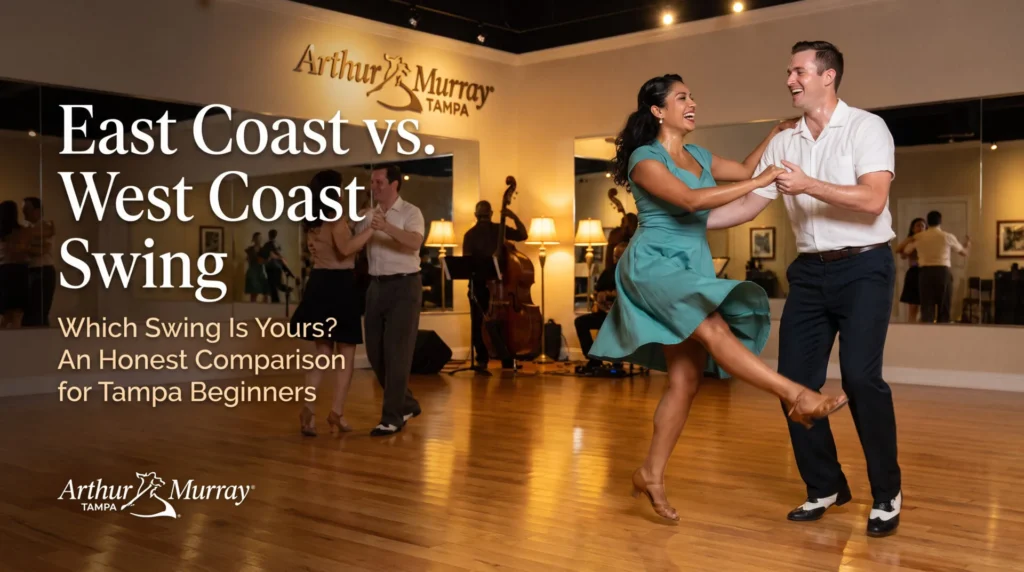
The clearest way to tell them apart is to watch the shape the couple makes on the floor. East Coast Swing rotates. West Coast Swing stays on a line.
Everything else follows from that one structural difference. The slot in West Coast Swing changes how the leader gets out of the way, how the follower travels and how the two dancers stay connected through the middle of a pattern.
The differences that matter on the floor
- Floor Pattern: East Coast Swing turns around a shared center point, so a couple occupies a circle. West Coast Swing keeps the follower moving along a straight lane while the leader steps aside and back into it.
- Tempo Range: East Coast Swing lives at faster tempos, the kind that make you want to move immediately. West Coast Swing sits noticeably slower, which gives you more time inside each beat.
- Connection Feel: East Coast Swing uses a springy, compact connection through the hands and frame. West Coast Swing uses a stretch-and-release connection that behaves like elastic, and that elasticity is what makes the dance look smooth.
- Body Motion: East Coast Swing carries a light vertical bounce. West Coast Swing stays level and grounded, with motion happening more through the feet and hips than up and down.
- Musical Home: East Coast Swing matches big band, jump blues, rockabilly and early rock and roll. West Coast Swing matches contemporary blues, pop, R&B and anything with a strong backbeat and room to breathe.
Both share the same DNA. The six-count and eight-count phrasing, the rock step, the underarm turn and the idea of leading and following a pattern rather than memorizing choreography all appear in each dance.
If you learn one, the other becomes easier. That is the practical takeaway, and it is the reason our Swing dance lessons in Tampa treat swing as a family of related dances rather than a single fixed routine.
Which swing dance should you learn first as a beginner?
Section Overview:
Beginners should generally learn East Coast Swing first. Its six-count basic repeats predictably, it works at the fast tempos most party and wedding playlists use, and it builds the rhythm and lead-and-follow skills that West Coast Swing later depends on. West Coast Swing is worth adding once you are comfortable staying on time and reading a partner’s connection.
The recommendation is not about difficulty for its own sake. It is about the order in which skills stack.
East Coast Swing gives you a repeatable frame to practice inside. Once the basic feels automatic, your attention is available for the harder work: hearing the music, holding a frame and communicating through your hands instead of your words.
How the skills build, in order
- Step One — Timing: You learn to hold a rhythm that repeats, so you stop counting out loud and start feeling the beat. East Coast Swing is built for this because the pattern comes back around quickly.
- Step Two — Frame: You learn to keep a consistent shape in your arms and torso so a partner can feel what you intend. Without a frame, no lead or follow works in any dance.
- Step Three — Turns and Redirection: You add underarm turns and simple changes of direction, which teach you to prepare a movement before it happens rather than yank it into place.
- Step Four — Elastic Connection: You learn to stretch and settle the connection rather than hold it rigid. This is the doorway into West Coast Swing, and it is far easier once steps one through three are reliable.
- Step Five — Musical Choice: You start deciding what to do with a phrase instead of running patterns end to end. West Coast Swing rewards this more than almost any other social dance.
There is no rule that forces this order. Some students fall in love with the slower, cooler feel of West Coast Swing and want it first, and that is a legitimate reason to start there.
What matters more is that you start. Our structured teaching process is designed so a complete beginner has a clear first step, a second step and a third, instead of being dropped into a crowded room and told to keep up.
Is West Coast Swing hard to learn?
Section Overview:
West Coast Swing is harder than East Coast Swing at the start, mainly because of its elastic connection and slower tempo. Slow music exposes timing errors that fast music hides, and the stretch-and-release feel takes repetition to internalize. It is not out of reach for beginners, but it usually takes longer before it feels comfortable on a social floor.
The common assumption is that slower music is easier. In practice the opposite is true for beginners, because a slow tempo leaves space where you have to decide what to do.
Fast music carries you. Slow music asks you to carry yourself, and that is the honest reason West Coast Swing takes more patience early on.
What makes it demanding, link by link
- Slower Tempo Creates Space: The extra time between beats means you cannot coast on momentum, and any hesitation becomes visible.
- Space Demands Connection: Because you are not being pushed along by speed, the partnership relies on a clear, continuous connection to know what happens next.
- Connection Demands Control: Stretch-and-release only works if both partners manage their own weight and balance rather than leaning on each other.
- Control Demands Repetition: Balance and elastic connection are physical habits, not concepts, so they arrive through practice rather than explanation.
- Repetition Produces Freedom: Once the habit forms, West Coast Swing becomes one of the most improvisational and conversational partner dances there is.
None of this means a nervous beginner should avoid it. It means the sequence matters, and a good instructor will not hand you the elastic connection before you can stand on one foot with confidence.
If you want a broader sense of how a dance program grows over time, our programs page lays out how private lessons, group classes and social practice work together.
Where does swing fit among the other dances you can learn in Tampa?
Section Overview:
Swing sits in the social-and-rhythm group alongside Hustle, Cha Cha and Salsa, and it is one of the most useful dances for real Tampa Bay events because so much party and wedding music suits it. Arthur Murray Tampa teaches Swing as a core social style at its South Tampa and Clearwater studios, in both group and private lessons.
Swing earns its place on the practical grounds of playlist coverage. Wedding receptions, waterfront parties and Saturday-night socials around Tampa Bay lean heavily on music that suits swing.
That makes it a high-return first dance for an adult who wants to be able to use what they learn. Once you have swing, you have an answer to a large share of the songs a DJ will actually play.
How swing compares to its social-dance neighbors
- Swing vs. Hustle: Both are social and playlist-friendly, but Hustle is built for disco and modern dance-floor tempos, with continuous turning rather than swing’s rock step.
- Swing vs. Cha Cha: Cha Cha is sharper and more compact, with a distinctive triple step and a Latin rhythm rather than a swung one.
- Swing vs. Salsa: Salsa runs on a different musical foundation and a different count, and it dominates Latin nights the way swing dominates classic-rock and big-band sets.
- Swing vs. Foxtrot: Foxtrot travels around the room in a smooth, elegant line and suits standards and jazz ballads, where swing stays in one area and plays with rhythm.
Swing for wedding couples
Swing is a frequent choice for couples planning a first dance, especially when the song has energy rather than a slow ballad feel. It photographs well, it fills a floor and it looks joyful rather than formal.
Couples working on a wedding dance often pair a swing pattern with a smoother dance so the routine has contrast. What matters is that the choreography fits your song, your dress and your comfort level, not somebody else’s idea of the right dance.
Swing for singles and social dancers
Swing is also one of the easiest dances to use as a single person, because it is a staple at social dance events and partner rotation is normal. You do not need to bring a partner to learn it or to dance it.
Both the South Tampa studio in Hyde Park and the Clearwater studio host social events where students practice what they have learned in a low-pressure setting. The studio calendar shows what is coming up.
Key Takeaways
- Shape Tells You Which Is Which: East Coast Swing rotates in a circle; West Coast Swing travels along a slot. That single structural difference drives everything else about the two dances.
- Music Decides the Match: Fast big band, rockabilly and classic rock call for East Coast Swing. Slower blues, pop and R&B call for West Coast Swing.
- Start With East Coast Swing: Its repeating six-count basic builds timing, frame and lead-and-follow habits that transfer directly into West Coast Swing and other social dances.
- Slower Is Not Easier: West Coast Swing’s slow tempo and elastic connection expose timing and balance issues, which is why it usually takes longer to feel comfortable.
- Swing Covers Real Playlists: Because so much wedding and party music suits it, swing is one of the most immediately usable dances for social events around Tampa Bay.
Start Swing Dance Lessons in South Tampa or Clearwater
If you have never danced before, the first lesson is not a test. It is a conversation about what you want to be able to do, followed by a short introduction on the floor with an instructor who expects you to be a beginner.
Arthur Murray Tampa has two studios: South Tampa in Hyde Park at 2111 W. Swann Ave., and Clearwater at 25032 US Hwy 19 N. To find out which location and format fit your schedule, get in touch with our team or call (813) 213-4681.
External References
- Arthur Murray International: Arthur Murray — background on the teaching method and the worldwide network of studios.
- National Dance Council of America: NDCA — the governing body overseeing competitive ballroom and social dance events in the United States.
- USA Dance: USA Dance — a national organization supporting amateur social and competitive partner dancing.